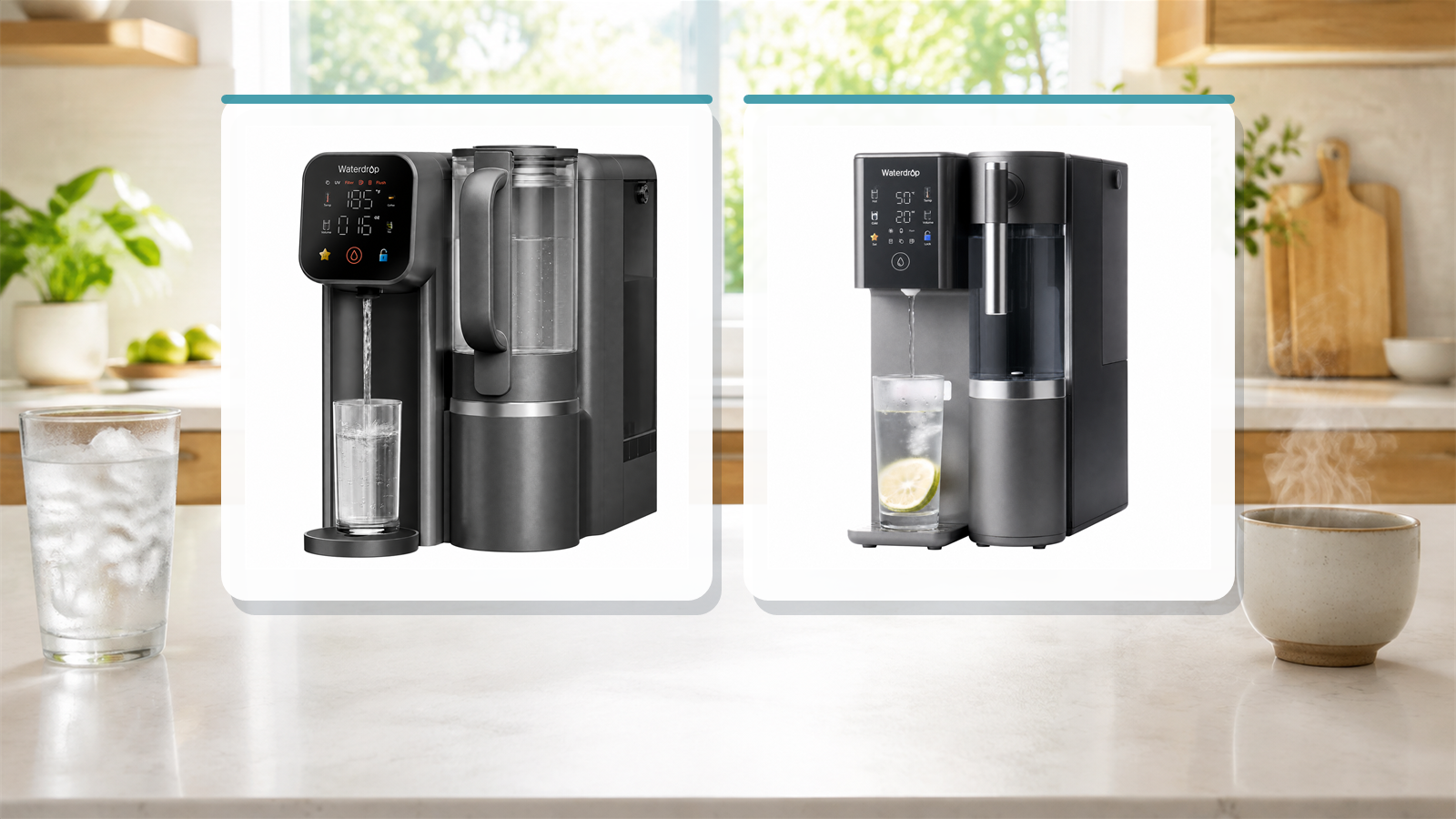
Waterdrop M6HG vs A2: Hot Water, Cooling, Remineralization, and Everyday Maintenance
The Waterdrop M6HG and A2 look similar enough to invite a simple specification comparison, but they are built around different routines. The M6HG prioritizes remineralized reverse-osmosis water, a glass pitcher, and several hot-water presets. The A2 trades integrated remineralization for active cooling, a larger feed tank, and higher rated production.
Waterdrop M6HG vs A2 at a Glance
| Feature | Waterdrop M6HG | Waterdrop A2 | Why It Matters |
|---|---|---|---|
| Core role | Remineralized ambient and hot RO water | Ambient, actively cooled, and hot RO water | This is the decision that outweighs most smaller differences. |
| Rated production | 75 GPD | 100 GPD | GPD is membrane capacity, not the speed of one glass. A2 has more headroom for heavier use. |
| Temperature choices | Room temperature plus 113, 149, 185, and 203 degrees F | Six presets spanning cold, ambient, and hot water from 59 to 203 degrees F | A2 cools; M6HG does not. Neither should be judged only by the number printed on the screen. |
| Remineralization | Integrated | Not integrated in the standard A2 | Mineral addition can change taste and mouthfeel, but it is not a substitute for checking treatment claims. |
| Portable pitcher | 40 oz glass | 40 oz lightweight plastic | The material difference is noticeable in handling, weight, and breakage risk. |
| Feed-water capacity | 135 oz feed section plus 50 oz waste section | 159 oz feed-water tank | Both are refillable countertop systems; neither is a continuous plumbed supply. |
| Manufacturer-listed ratio | 3:1 pure to drain | 3:1 pure to drain | Actual recovery changes with feed-water temperature, dissolved solids, flushing, and measurement method. |
| Listed certification | NSF/ANSI 58 and 372 | NSF/ANSI 372 | Standard 372 concerns lead content in materials; it is not the same as certified contaminant-reduction performance. |
| Dimensions | 15.9 x 9.3 x 14.5 in | 15.9 x 8.2 x 15.7 in | A2 is narrower but taller and deeper. Rear and overhead clearance still matter. |
| Replacement filter rating | M6RFG: up to 12 months or 1,100 gallons | A2RF: up to 12 months or 1,100 gallons | Harder or more contaminated feed water can shorten practical life. |
The table uses current manufacturer specifications, but rated capacity is not a promise that every household will see the same output. Water temperature, source-water chemistry, household volume, automatic flushes, and elevation all change real behavior.
What the M6HG Is Better At
The M6HG makes the strongest case when the goal is pleasant everyday drinking water and predictable hot-water presets without installing anything under the sink. Its remineralization stage adds selected minerals after reverse osmosis. That can give the water more body than very low-TDS RO water, which some people describe as flat, but taste remains personal and depends on the incoming water.
The 40 oz glass pitcher is the other meaningful advantage. It feels more substantial, avoids keeping finished water in a plastic carafe, and can move from the dispenser to a dining table or refrigerator. Glass also adds weight and breakage risk, so it is not automatically better for children, busy offices, or anyone who wants a light one-handed container.
M6HG makes sense for
- tea, pour-over coffee, oatmeal, and other hot-water routines;
- buyers who specifically want an included glass pitcher;
- people who prefer a remineralized taste after RO;
- renters who cannot add plumbing and do not need active cooling.
M6HG compromises
- no compressor cooling or chilled-water reservoir;
- lower rated production than A2;
- automatic pitcher behavior may not suit people who want filtration only on demand;
- independent evidence is still thinner because this is the newer model.
A multi-week independent review found the M6HG convenient in a hard-water household, but also noted practical details that do not stand out in a feature list: several initial rinse cycles were needed, the new-machine taste took time to settle in that unit, and tall 0.75- or 1-liter bottles did not fit comfortably below the outlet. Another recent owner report objected to the automatic pitcher-refill routine and the handling of the first hot-water serving. These are individual experiences, not failure-rate data, but they identify useful tests for the return window.

What the A2 Is Better At
The A2 is the stronger all-purpose appliance. It filters, heats, and actively cools, so one counter footprint can replace a pitcher filter, a kettle for many tasks, and part of the refrigerator-water routine. Its 100 GPD membrane rating and 159 oz feed tank also make more sense for a household that fills several glasses and bottles throughout the day.
Cooling is the feature to examine most carefully. An independent 2026 test measured roughly 46 to 53 degrees F from the cold setting, which is genuinely refreshing, but only the first 16 oz remained fully chilled after the cooling cycle. The same testers estimated about 45 minutes to restore the cold reserve. That is useful for one or two glasses; it is not the same as filling a large family pitcher with refrigerator-cold water on demand.
Hot-water performance also deserves a thermometer test. The same review measured the 113, 149, and 185 degrees F presets reasonably close to their targets, but the nominal 203 degrees F setting reached about 189 degrees F in that sample. A separate three-week review reported a similar ceiling near 186 degrees F at approximately 2,500 feet elevation. The A2 includes a boiling-point adjustment mode, yet elevation and incoming-water temperature still matter.

Filtration Evidence: Similar Category, Different Confidence
Both machines use reverse osmosis, but the number of advertised stages is a weak comparison by itself. One manufacturer may count prefiltration, membrane, post-carbon, UV or LED treatment, and mineral media separately; another may combine them. The membrane, certified claims, feed-water limits, maintenance, and final taste are more useful than an eight-versus-five-stage headline.
A2 has more independent test data
In one recent laboratory comparison using a municipal tap-water sample, the A2 reduced TDS by about 95 percent. Chlorine, several disinfection byproducts, copper, iron, nitrate, fluoride, barium, boron, and strontium fell below that lab’s reporting limits, while manganese reduction was much weaker. This is encouraging evidence for that sample, not a universal contaminant-removal guarantee. A filter cannot reduce a compound that is not present in the test water, and laboratory results change with concentration, sampling, and membrane condition.
Waterdrop lists NSF/ANSI 372 for the A2. That standard addresses lead content in materials that contact drinking water; it should not be read as certification for every reduction claim on a sales page. If a specific contaminant drives the purchase, compare the exact certified performance sheet with a current test of the home’s tap water.
M6HG has the stronger listed certification set
Waterdrop lists the M6HG under NSF/ANSI 58 and 372. Standard 58 is the relevant RO-system performance standard, while 372 addresses lead content. Certification scope still matters: buyers should confirm the exact model number, certificate holder, and reduction claims covered by the current listing rather than assuming that every marketing claim is certified.
The M6HG’s remineralization stage is principally a taste and formulation difference. Added calcium, magnesium, potassium, sodium, strontium, zinc, and silica are named in current product materials, but the actual concentration in a glass can vary. It would be misleading to turn that ingredient list into a medical benefit.
Pitcher Workflow Changes the Experience
Both models provide a removable 40 oz pitcher, but they do not feel identical in use. The M6HG’s glass vessel is heavier and more stable. The A2’s plastic carafe is easier to lift and less worrying around a hard sink, but buyers avoiding plastic contact may consider it a drawback.
The pitcher is not just an accessory. Ambient water stored in it is immediately available for cooking, pet bowls, a coffee machine, or the refrigerator. Water dispensed directly from the front outlet may be slower, especially at hot settings, because the appliance is controlling temperature as it pours.
Storage also affects taste. One M6HG owner reported that freshly filtered water tasted good but became less pleasant after sitting in the pitcher. That isolated report does not establish a model-wide problem, although it is a reason to test stored water after one hour and again the next morning. Wash the pitcher as directed, keep it covered where possible, and avoid leaving finished water warm for long periods.
Setup: The First Day Is Not Representative
Countertop RO removes plumbing work, but it does not eliminate commissioning. New filters release air and fine carbon particles, internal tanks need rinsing, and new plastics or seals can contribute temporary taste or odor. Several independent A2 reviewers needed multiple full flush cycles before the water tasted neutral. One test used a container larger than 52 oz during priming and kept roughly eight inches of clearance behind the machine for access and ventilation.
- Measure the counter first. Include room to lift the feed tank, remove the filter, open nearby cabinets, and ventilate the rear of the A2’s cooling system.
- Complete every required flush. Do not shortcut the manual because the display appears ready. Discard all water the instructions designate as flushing water.
- Run a taste baseline. Compare fresh water, pitcher water after an hour, and pitcher water after refrigeration. A clean glass avoids blaming the machine for detergent or refrigerator odors.
- Measure real temperature. Test the cup sizes and presets used for coffee, tea, formula preparation, or cold drinking water. Follow the beverage or formula maker’s safety guidance rather than relying on a generic preset label.
- Check volume accuracy. Dispense into a measuring jug. Preset volume can differ slightly because the flow tapers when the machine stops.
- Log refill and waste frequency. Count complete feed-tank refills for two normal days. This is more informative than the rated GPD number.
- Listen through a full cycle. Pumps, automatic flushing, heating, and A2 compressor cooling occur at different times. A quiet dispense does not describe the entire noise pattern.
Water Use and the 3:1 Claim
A 3:1 pure-to-drain ratio means three parts finished water for one part concentrate under the manufacturer’s test conditions. It does not mean the waste compartment will always fill at exactly that pace. Automatic flushing, cold feed water, high TDS, scale, and a partially exhausted filter can reduce recovery.
An independent A2 test measured approximately 2.0 parts purified water to one part waste. That does not necessarily disprove the rated figure because test boundaries differ: one measurement may include flush water while another uses steady-state membrane output. For a useful home result, measure how much tap water enters and how much finished water is available across several complete tank cycles.
Do not pour concentrate back into the feed tank unless the manual explicitly allows it. Reprocessing already concentrated water raises dissolved-solids load and can shorten membrane life. If local rules and household practices permit, RO concentrate may be collected for non-potable cleaning rather than drinking or cooking.
Maintenance and Long-Term Cost
Both current replacement cartridges are rated for up to 12 months or 1,100 gallons. Treat that as a maximum service interval, not a guaranteed year. A high-TDS supply, frequent hot-water use, low feed-water temperature, or unusually high consumption can move replacement earlier. A filter-life indicator estimates usage; it does not analyze every contaminant or prove the membrane is intact.
Weekly habits
- wash and fully rinse the removable pitcher;
- empty and clean the drip tray before standing water develops odor;
- inspect the feed and waste areas for film, scale, or trapped debris;
- wipe the outlet without pushing material into the nozzle.
Periodic checks
- follow the model-specific descaling procedure in hard-water areas;
- compare dispense time with the new-filter baseline;
- check for unexplained TDS or taste changes;
- replace seals or filters only with compatible parts.
The two models use different cartridges, so availability matters as much as list price. A reasonable ownership check is to confirm that the exact M6RFG or A2RF filter can be purchased independently, then budget at least one cartridge per year. Electricity use will normally be higher for the A2 because active cooling cycles on and off; actual cost depends on settings, room temperature, and standby behavior.
Which One Fits Your Routine?
Choose the Waterdrop M6HG when
- you drink mostly ambient or hot water and can refrigerate a pitcher separately;
- a glass finished-water vessel is a priority;
- you prefer the taste of remineralized RO water;
- the manufacturer’s listed NSF/ANSI 58 certification is important and you have verified its exact scope;
- 75 GPD is comfortably above the household’s drinking and cooking demand.
Choose the Waterdrop A2 when
- cold water on demand matters more than integrated remineralization;
- several people will use the machine and the larger feed tank is useful;
- you want saved temperature and volume settings plus a hot-water child lock;
- a lightweight plastic carafe is acceptable;
- you understand that the chilled reserve is limited and the hottest preset may finish below the display target.
For most tea- and coffee-focused buyers, the M6HG is the cleaner choice because cooling hardware adds cost and complexity without helping the main routine. For mixed households where one person wants hot tea and another wants a cold glass, the A2 earns its larger role. Buyers who need both active cooling and integrated remineralization should compare the separate A2G rather than assuming the standard A2 includes the mineral stage.
Bottom Line
The Waterdrop M6HG vs A2 decision is less about which machine has more features and more about which inconvenience you would rather manage. M6HG owners must chill water elsewhere and accept the behavior of an automatically filled glass pitcher. A2 owners get real cooling, but only a limited chilled batch, a plastic carafe, compressor cycles, and less extensive listed certification.
Before choosing, compare current availability, tracked prices, and any verified promotions on the Waterdrop coupon codes, water-filter deals, and tracked price offers page. The live product cards above remain the better place to judge price because both models and their promotions change independently.
Frequently Asked Questions
Does the Waterdrop M6HG cool water?
No. The M6HG dispenses room-temperature or heated water. Its removable glass pitcher can be placed in a refrigerator, but the machine itself does not actively chill water.
Does the Waterdrop A2 remineralize RO water?
The standard A2 does not include the integrated remineralization stage found in the M6HG. Waterdrop sells a separate A2G model for buyers who want hot, cold, and remineralized water in that platform.
Which model has a glass pitcher?
The M6HG includes a 40 oz glass pitcher. The A2 uses a 40 oz lightweight plastic carafe.
Is Waterdrop A2 water refrigerator-cold?
An independent test measured roughly 46 to 53 degrees F, which feels cold, but only about the first 16 oz stayed fully chilled in that test. It is suitable for a glass or two, not necessarily a large cold-water refill without recovery time.
Can the A2 replace a kettle?
It can replace a kettle for many drinks and quick cooking tasks, but the hottest output may not reach the displayed 203 degrees F. Independent reviewers measured roughly 186 to 189 degrees F in their units, with elevation and feed-water temperature among the possible variables.
How often do M6HG and A2 filters need replacement?
Both current cartridges are rated for up to 12 months or 1,100 gallons. Replace earlier when the machine instructs you to, when flow or water quality changes unexpectedly, or when the manual’s service limit is reached.
Which Waterdrop model is better for hard water?
Both use reverse osmosis, which can reduce dissolved minerals that cause scale, but hard water can increase membrane load and descaling needs. The better choice depends on tested source-water chemistry, permitted feed-water limits, and willingness to maintain the machine.
Independent Testing and Owner Discussions
- BOS Water: Waterdrop A2 laboratory analysis and hands-on testing
- Trail & Kale: Waterdrop A2 setup, taste, and daily-use review
- TechWalls: month-long Waterdrop A2 review
- TuttoTech: multi-week Waterdrop M6HG review
- Reddit: Waterdrop A2 owner and buyer discussion
- Reddit: Waterdrop M6HG pitcher and stored-water discussion
- Trustpilot: model-specific M6HG owner report