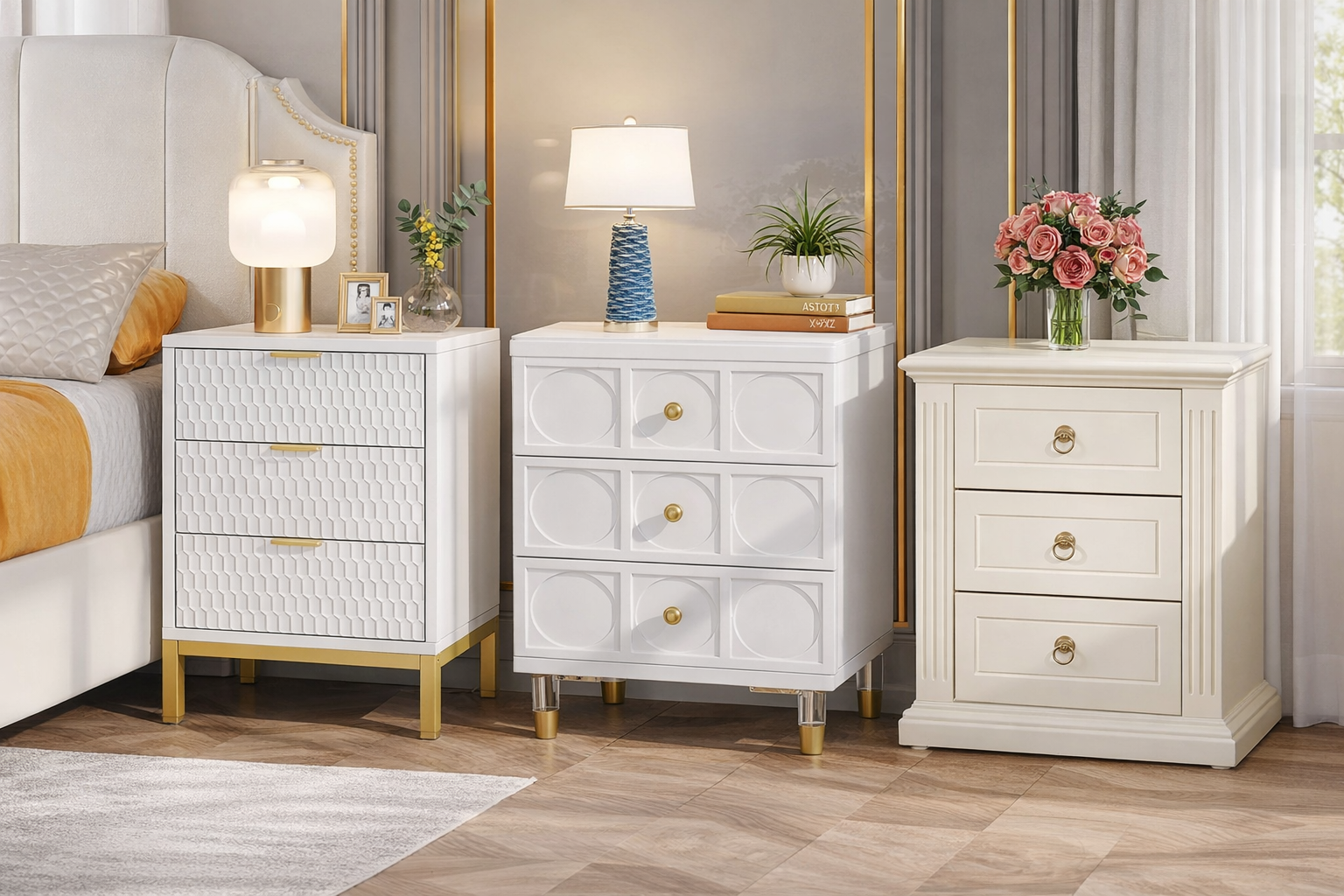
The Ultimate Guide to Choosing the Perfect 3-Drawer End Table Bedside for Your Bedroom
A bedside table has a deceptively difficult job. It needs to hold a lamp, a phone, a book, water, glasses, and the small objects that seem to appear beside the bed every night. It also has to fit between the bed and the wall, sit at a comfortable height, open without hitting the mattress, and look as though it belongs with the rest of the room. A three-drawer end table can solve the storage problem, but only if its proportions are right.
The best 3-drawer bedside table is not automatically the largest one or the most decorative one. It is the table that matches the bed height, gives each drawer a purpose, leaves enough surface for the lamp and evening essentials, and does not make a small bedroom feel crowded. This guide compares several current Tribesigns designs and focuses on the decisions that matter after the furniture arrives: access, scale, organization, cleaning, assembly, and everyday comfort.
I find three drawers especially useful because they create a natural separation between things used every night, occasional personal items, and the visual clutter that would otherwise stay on top. But drawer count is only the beginning. Width, depth, leg style, finish, and the amount of open space around the piece will determine whether it feels practical or oversized.
Why Choose a Three-Drawer Bedside Table?
One drawer is enough for a few essentials, but it fills quickly. Two drawers are better, although the top one often becomes a catch-all for chargers, reading glasses, receipts, and anything else that has no obvious home. Three drawers allow you to organize by frequency rather than simply pushing everything into the nearest empty space.
The top drawer can hold the items you reach for in bed: a sleep mask, glasses, a remote, medication that has been stored safely, or a small notebook. The middle drawer can take cables, spare batteries, and personal accessories. The bottom drawer is useful for books, extra linens, or larger items that do not need to be visible. That arrangement keeps the tabletop calmer without requiring a separate dresser for every small object.
Three drawers also help in a guest room. Visitors can use one drawer for personal belongings, another for chargers or travel items, and the third for anything that should remain out of sight. In a living room, the same style can function as an end table with storage for remotes, coasters, games, or reading material.
Start With the Bed, Not the Table
The most common bedside-table mistake is choosing a piece from a product photo before measuring the bed. A nightstand that looks balanced online may be too low beside a tall mattress or too high next to a low platform bed. Measure from the floor to the top of the mattress, then compare that measurement with the height of the table’s usable surface.
The ideal surface is usually close to mattress height or a little below it. You should be able to reach a lamp switch, glass, or phone without lifting your shoulder or leaning across the bed. A difference of a few inches is not automatically a problem, but a dramatic mismatch makes everyday use awkward and can make the furniture look disconnected from the bed.
Do not measure only the mattress. Include a thick topper, a box spring, a bed frame, or any platform that will remain in the room. If the table will sit beside a bed with a deep side rail, check whether the drawers open into the rail or whether the table must sit slightly forward.
| Bedside situation | What usually works | What to watch |
|---|---|---|
| Tall bed or thick mattress | A taller nightstand or a wider piece with a surface near mattress height | A low table can make the lamp and essentials difficult to reach |
| Low platform bed | A compact table with a lower profile and clean horizontal lines | A tall chest can visually overpower the bed |
| Small bedroom | A narrow footprint with drawers rather than a wide open shelf | Check drawer clearance and the walking path beside the bed |
| Large primary bedroom | A wider 31.5- or 36-inch design can balance a substantial bed | Leave enough space for the drawers to open fully |
31.5 Inches: A Useful Middle Ground
The 31.5-inch-wide modern nightstand is a good example of a table that gives you real surface area without immediately becoming a dresser. Its three drawers provide hidden storage, while the width leaves room for a lamp, a phone, and a small stack of books. It makes the most sense beside a larger bed or in a bedroom where a narrow one-drawer table would look undersized.
The clean lines and contemporary finish make this size relatively easy to place. It can sit beside a modern upholstered bed, a simple wood frame, or a guest-room bed where you want the furniture to feel useful rather than ornate. Because the product is described as a bedside end table, it can also move to a sofa or reading area if the bedroom layout changes.
The trade-off is floor space. A 31.5-inch width needs a proper measurement, especially if two tables will sit on either side of a queen or king bed. Leave enough room to stand, make the bed, and open the drawers without turning the bedside area into a narrow corridor.
How Much Width Do You Really Need?
Width should follow the objects you plan to keep on top. A small lamp and phone need much less space than a wide lamp, a humidifier, a book stack, and a decorative tray. Draw a rectangle on the floor with painter’s tape or paper before buying. It gives a more honest sense of how much the table will project into the room than a product image does.
Depth matters just as much. A deep table may provide generous storage, but it can make the bed feel boxed in. In a narrow room, a slightly wider but shallower piece may be easier to live with than a compact table that extends too far toward the walking path.
For a pair of nightstands, symmetry is attractive but not mandatory. Matching tables create a calm, hotel-like look. Two different tables can work when their heights are similar and they share a finish, material, or visual weight. If one side needs more storage than the other, a three-drawer table on one side and a smaller table on the other can be more practical than forcing identical furniture into an uneven room.
The 36-Inch Oversized Option
A 36-inch oversized nightstand is closer to a compact bedside dresser. The advantage is obvious: there is much more room for a larger lamp, books, framed photos, and objects that would overwhelm a smaller table. The three drawers add genuine storage rather than just decorative detail.
This size works best beside a wide bed, a substantial headboard, or a bedroom with enough open floor around the furniture. It can anchor a large wall and prevent the bedside area from looking empty. It is also useful when one table needs to serve two people, although shared storage should be planned so the top drawer does not become a nightly argument disguised as furniture.
The oversized format is less forgiving in a small room. Before choosing it, open the imaginary drawers into the space and check the distance to the foot of the bed, a nearby door, and any heating vent. If the table blocks the natural path around the bed, its extra storage will not feel like a benefit.
Drawer Layout: What Belongs Where?
A three-drawer table works best when the drawers are treated as zones. The precise internal dimensions vary by design, so check the product measurements before buying bulky objects, but the general idea is simple: keep the most frequently used things closest to the top and move seasonal or occasional items down.
Glasses, sleep accessories, a small notebook, remotes, and other items used immediately at bedtime.
Charging cables, spare batteries, headphones, hand cream, or personal accessories that need to stay organized.
Books, extra reading material, small linens, or items that are useful but not needed every night.
Keep only what benefits from being visible: a lamp, phone, water, and perhaps one personal object.
Drawer storage is particularly helpful for light-sensitive sleepers. A closed drawer removes visual noise from the room and keeps small indicator lights, cables, and shiny objects from competing with a bedside lamp. It also makes cleaning quicker because fewer things need to be moved from the surface.
Modern, Farmhouse, or Classic?
Style should be considered after size and function, but it still affects how the table feels at night. A modern design with clean lines and a metal frame can make a bedroom look lighter and more structured. A farmhouse table with patterned fronts or a distressed finish introduces warmth and becomes a stronger decorative feature.
Think about the furniture that is already in the room. If the bed has a tall upholstered headboard, a strongly patterned nightstand may compete with it. If the room is mostly plain wood and neutral bedding, a decorative drawer front can give the wall more character. The goal is not to match every surface exactly. It is to repeat one or two visual cues so the room feels intentional.
| Style direction | Works well with | Possible drawback |
|---|---|---|
| Clean modern | Upholstered beds, simple lighting, neutral colors, metal accents | Can feel visually cold if the room has no soft textures |
| Farmhouse patterned | Wood beds, woven baskets, linen bedding, warm lamps | Decorative fronts may become the room’s strongest focal point |
| Round or softened shape | Small rooms, curved headboards, modern or bohemian interiors | Usable top area can feel smaller than a rectangular table of similar width |
| Traditional rectangular | Guest rooms, classic bedrooms, mixed furniture, practical layouts | May look ordinary if the rest of the room needs a stronger design element |
Farmhouse Details Without a Full Rustic Makeover
The farmhouse 3-drawer nightstand with elegant patterns is useful for shoppers who want texture without replacing the entire bedroom. Its drawer fronts provide more visual interest than a plain box, while the three-drawer layout remains practical. It can work with warm wood, woven baskets, cream bedding, and aged-metal lighting, but it does not require every item in the room to be rustic.
I would use this style when the nightstand needs to add personality to a guest room or a bedroom with simple walls. The patterned surface becomes a small piece of furniture-focused decoration. Keep the objects on top restrained so the table does not look busy: one lamp, a book, and a small tray are usually enough.
The product description emphasizes straightforward assembly, which is worth considering with decorative furniture. More visual detail can mean more parts or more opportunities for panels to be installed in the wrong orientation. Lay out the pieces before starting and avoid tightening every screw fully until the frame is aligned.
Round Nightstands: A Softer Alternative
A round side end table changes the way a bedside corner feels. The softened silhouette can make a narrow walkway seem less rigid, and it works well when the bed, mirror, or lighting already includes curves. The current round three-drawer model is listed as requiring no assembly, which is a meaningful convenience for anyone who does not want to build a cabinet beside the bed.
The round form is not only about appearance. It reduces sharp corners near a walking path and can make the furniture easier to approach from an angle. That can be helpful in a smaller bedroom or next to a bed that sits close to another piece of furniture.
There is a practical compromise: the usable top surface may feel less efficient than a rectangular top, especially if you use a wide lamp. Measure the lamp base and the objects you want nearby. A round table is a good choice when the silhouette matters and the top can remain intentionally uncluttered.
Materials, Stability, and Daily Wear
Nightstands are touched more often than many larger furniture pieces. Drawers open before bed, the top collects a glass ring, and the edges are exposed to phone chargers, books, and cleaning cloths. The best material is the one that fits your routine and your willingness to maintain it.
Engineered wood can be practical and consistent, especially when the finish is even and the drawer slides are smooth. Solid wood brings a different weight and texture, but it may also show changes in grain and require more care around moisture. Metal frames can make a design feel lighter while adding structure, though the combination of metal and drawer panels should be checked for wobble after assembly.
Stability matters more than a heavy appearance. Place the table on a level surface, adjust any feet if the design includes them, and do not overload the top with a very large lamp or stacked equipment. If children or pets regularly pull on drawers, an anti-tip strategy and careful placement become part of the decision, even when the product listing focuses mainly on style.
Assembly: The Part That Determines How Good It Looks
Many three-drawer nightstands arrive as flat-pack furniture. Assembly is not a minor inconvenience because a cabinet that is slightly out of square can develop uneven drawer gaps, stiff runners, or a top that does not sit flush. The final appearance depends as much on careful assembly as on the product photography.
Read the instructions once before opening the hardware. Separate similar screws, keep the drawer panels in order, and use a soft surface so the finish does not pick up scratches. When a step says not to tighten the hardware completely, follow it. Frames often need a little movement until the back or top panel is aligned.
Confirm the assembled footprint and the space beside the bed before carrying the box upstairs.
Assemble on a blanket or clean cardboard and avoid dragging panels across the floor.
Check that the cabinet sits evenly before tightening the final screws.
Open and close them before loading the table so misalignment is easy to correct.
If assembly is a deciding factor, the round no-assembly option is worth comparing with traditional rectangular designs. A piece that arrives ready to use may be more valuable than a slightly cheaper one if the table is needed quickly or the buyer does not have a comfortable place to build furniture.
What Makes a Good Bedside Surface?
Three drawers solve hidden storage, but the top surface still needs a plan. A bedside table works best when the visible objects are limited to the things that support the evening routine. A lamp should have a stable base and a cord that can run safely toward the wall. The phone needs a charging location that does not require it to balance on a book. Water should sit where it is easy to reach but not where a small spill will run directly into an open drawer.
Use a shallow tray for loose items if the table is wide enough. It creates a boundary for glasses, keys, or jewelry and makes the surface easier to clear. Avoid placing a tall decorative object in front of the lamp or against the bed, where it can become an obstacle rather than an accent.
On a large 36-inch table, empty space is part of the design. Do not feel obligated to fill the whole width. On a smaller round or narrow table, select a lamp with a compact footprint and store books inside the drawer rather than building a stack that competes with the bed.
Three Drawers Versus Open Shelves
Open shelving gives quick access and can make a small table look lighter. It is useful for books, baskets, and decorative objects that you want to see. The downside is that it requires visual discipline. Every cable, receipt, and spare item remains part of the room’s appearance.
Drawers are better when you want a calm, closed surface. They hide the practical mess of modern life and protect personal items from dust and direct light. They are less convenient for objects you reach for constantly, but the top drawer solves much of that problem.
| Storage type | Best for | Bedroom feel |
|---|---|---|
| Three drawers | Personal items, cables, books, and anything you want out of sight | Calmer and more visually controlled |
| Open shelf | Books, baskets, blankets, and objects that benefit from quick access | Lighter, but more dependent on tidy styling |
| Drawer plus shelf | A mix of hidden essentials and displayed items | Flexible and approachable in guest rooms or living spaces |
Using a Three-Drawer Table Beyond the Bedroom
A good nightstand does not have to stay beside the bed forever. The modern metal-frame design can work as an end table beside a sofa, especially when the room needs a small storage piece rather than another open shelf. The round design can move to a reading corner or hallway where its softened shape makes sense.
In a guest room, the three drawers give visitors a place to unpack small items without taking over a dresser. In a nursery or child’s room, use caution with placement and drawer access, but the storage capacity can help keep nighttime supplies nearby. In a home office, the table can hold cables, notebooks, and small equipment if the top remains clear for a lamp or plant.
This flexibility is one reason to avoid choosing a style that only works with the current bed. A neutral finish and a useful footprint can follow you through a move or a room redesign. Furniture costs less to live with when it has more than one possible role.
Common Buying Mistakes
- Buying by width alone and forgetting the table’s depth, height, and drawer clearance.
- Choosing a nightstand before measuring the mattress and bed frame together.
- Assuming three drawers mean three large drawers without checking the internal dimensions.
- Placing a wide lamp on a small or round surface where it leaves no room for a phone or water.
- Choosing a dramatic finish that competes with a patterned headboard, rug, or bedding.
- Ignoring the assembly space, stair access, and the need to test drawer alignment.
- Forgetting that a bedroom needs walking space and that every open drawer temporarily uses more of it.
My Shortlist by Bedroom Type
| Bedroom or use case | Most sensible direction | Why |
|---|---|---|
| Small room or narrow walkway | Round three-drawer table or a compact rectangular design | Softer edges and controlled depth help preserve movement around the bed. |
| Large primary bedroom | 36-inch oversized nightstand | The wider top and three drawers balance a substantial bed and larger lamp. |
| Modern bedroom | 31.5-inch modern table or metal-frame design | Clean lines provide storage without adding a heavy traditional shape. |
| Farmhouse or warm guest room | Patterned farmhouse three-drawer nightstand | Decorative fronts add character while retaining useful closed storage. |
Final Thoughts
A three-drawer end table bedside can make a bedroom feel noticeably more settled. It gives the small things a place to go, creates room for a proper lamp, and keeps the surface from becoming a nightly pile of cables and books. But the right choice depends on the room’s measurements and the person’s habits more than on a product label.
Measure the bed first, decide how much top space you need, and then choose the visual style that supports the room. A 31.5-inch table is a useful middle ground. A 36-inch model works when the bedroom can handle a larger piece. A round table softens a tight corner, while a farmhouse design adds pattern and warmth. Each can be the perfect bedside table in the right room.
The most successful nightstand is the one that disappears into the routine: the lamp is easy to reach, the drawer opens smoothly, the phone has a safe place, and the room looks calm when the day is over.
Questions to Ask Before Buying
How tall should a three-drawer nightstand be?
Its usable top is usually most comfortable when it is close to the top of the mattress or slightly below it. Measure the complete bed height, including the frame, box spring, mattress, and topper.
Is a three-drawer nightstand too large for a small bedroom?
Not necessarily. A narrow or round design can provide useful storage in a small room, but measure the walking path and drawer clearance before choosing a wider model.
What should go in the three drawers?
Use the top drawer for nightly essentials, the middle drawer for cables and personal accessories, and the bottom drawer for books, linens, or less frequently used items.
Are round bedside tables practical?
They can be. A round table softens a tight corner and can be easier to approach from an angle, but its top surface may hold less than a rectangular table of similar width.
Should both bedside tables match?
Matching tables create symmetry, but two different pieces can work when their heights and visual weight are compatible. Choose based on storage needs and the layout of each side of the bed.
After measuring your bed and deciding how much storage you need, compare the current bedside tables, sizes, and available offers on the Tribesigns coupons and deals page. The best table is the one that fits the room and the nightly routine, not simply the one with the largest drawers.