Eagle Gate Operators: The 2026 Engineering Review
A gate operator is easy to underestimate. From a distance, it looks like a motor, a control box, and a remote. In practice, it is the part of a gate system that has to deal with weight, friction, weather, repeated starts, safety sensors, access control, and the occasional moment when a vehicle is parked exactly where it should not be. The right operator is therefore less about choosing the largest horsepower number and more about matching the machine to the gate in front of it.
This 2026 engineering review looks at Eagle gate operators as a range rather than a single product. The lineup covers residential sliding gates, heavier sliding gates for light commercial use, commercial swing gates, and high-traffic sliding systems. I am focusing on the practical engineering questions that matter after installation: how the gate moves, how much reserve the motor needs, what the release system does, how the controls fit into a complete access system, and which details deserve attention before the first hole is drilled.
The product information below is useful for narrowing the field, but it is not a substitute for the current manufacturer manual, local electrical requirements, or a qualified gate installer. Gate size and weight ratings are starting points. A gate that rolls badly, sits on a slope, catches wind, or cycles far more often than expected can require a different solution.
What Makes a Gate Operator a Good Match?
The first question is not whether an operator is powerful. It is whether the operator can move the gate smoothly, consistently, and safely under the conditions it will actually experience. A lightweight gate with excellent rollers may be easier to move than a nominally lighter gate with seized bearings, a bent track, or a chain that is not aligned.
Length and weight are still important because they help define the mechanical load. The gate also needs room to travel, a stable stop at the open and closed positions, and enough clearance for the operator and chain system. With swing gates, the operator must work through the geometry of the hinges, posts, arms, and opening angle. A model that looks adequate on paper can be unsuitable if the hinges are out of line or the gate post does not provide the required mounting space.
Duty cycle matters just as much. A private driveway may open a handful of times per day. An apartment entrance, warehouse, farm, or business parking area may cycle continuously during busy periods. Heat, repeated starts, and long operating hours put a very different demand on the motor, control board, gearbox, and safety system.
Sliding Gates and Swing Gates Are Different Problems
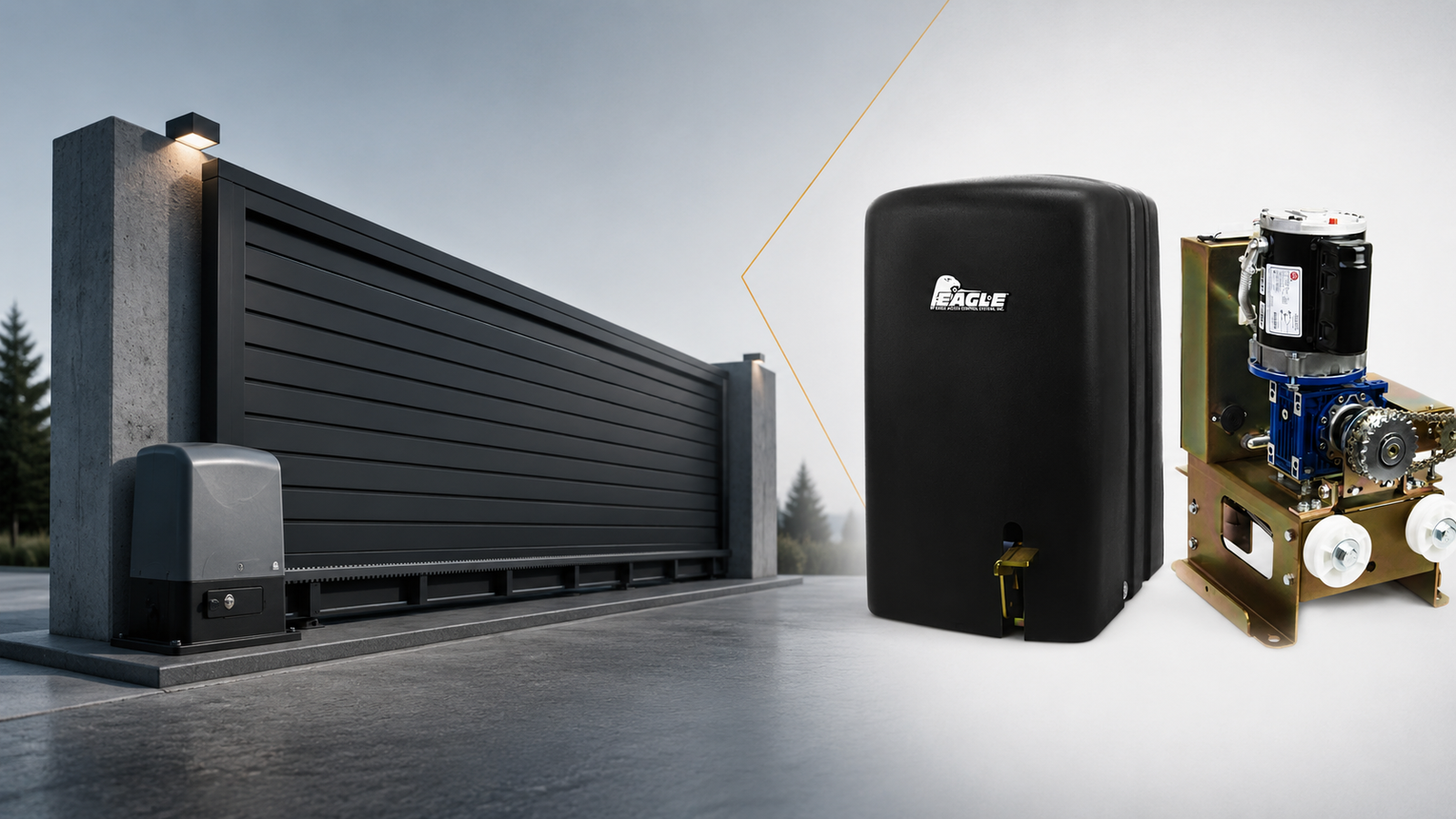
A sliding gate moves sideways along a track or a supported rolling system. Its operator normally drives a chain or rack attached to the gate, so the condition of the rollers and the straightness of the travel path have a direct effect on the motor. The gate also needs a dependable end stop and enough room to slide fully clear of the opening.
A swing gate rotates around hinges. The operator has to push or pull the leaf through an arc, and the load changes as the gate moves. Post position, hinge friction, wind exposure, gate width, and the desired opening angle are all part of the calculation. A double swing gate introduces another layer of coordination because both leaves must start, stop, and close in the intended order.
That distinction is why a commercial swing operator should not be selected simply because its horsepower appears similar to a sliding operator. The drive method and the installation geometry are different. The safest comparison begins with the gate movement, then moves to the load and operating frequency.
Where the Residential Eagle-1 Fits
The Eagle-1 is the most approachable model in this comparison for a private sliding gate. The current listing describes a 1/2 HP operator for gates up to 18 feet and 300 pounds, with two wireless remotes, a receiver, and a monitored reflective photo eye. That combination makes sense for a home driveway where the gate is reasonably light, the track is in good condition, and the usage pattern is moderate.
What I like about this kind of package is that the basic control accessories are not treated as an afterthought. A receiver and remotes make the system usable from day one, while a monitored photo eye gives the installer a starting point for the safety circuit. The fail-safe manual release crank is also important in a residential setting. A power outage should not turn a driveway gate into a permanent barrier, and the release needs to remain accessible and usable when the motor is not energized.
The 18-foot and 300-pound limits should be read as system limits, not targets to approach casually. A gate close to the maximum length, mounted on a rough track, may impose more stress than a shorter gate that rolls freely. Before choosing the operator, disconnect the drive and check that the gate can travel by hand without sticking, dropping, or requiring a sudden push at one point in the cycle.
Eagle 1000 FSC for a Larger Residential or Light Commercial Gate
The Eagle 1000 FSC moves the discussion beyond a typical home driveway. The current product data describes a 1/2 HP continuous AC motor for sliding gates up to 27 feet and 600 pounds, together with two wireless remotes, a receiver, a retro-reflective sensor, a non-weld chain kit, and a fail-secure crank-to-open arrangement.
The extra capacity is useful when the gate is physically larger or when the entrance sees more regular traffic. It does not mean that a poorly maintained gate becomes acceptable. The track, rollers, guide hardware, and stops still need to be correctly installed. A larger operator can mask a mechanical problem for a while, but the added strain eventually shows up as noise, heat, inconsistent movement, or premature wear.
The fail-secure wording deserves a careful reading before installation. It describes how the gate is intended to behave in relation to a power failure and the manual release, but the correct access and emergency strategy depends on the site. A home, a business, and a fire-access route may have different requirements. The installer should confirm the required behavior, the location of the release, and the interaction with any keypad, loop detector, intercom, or building access system.
This model is a sensible middle ground when a residential operator would be too close to its limits, but a full high-traffic industrial package would be excessive. It is especially important to confirm the actual gate weight rather than estimating from the frame alone. Wood infill, steel panels, decorative cladding, and wet conditions can change the load considerably.
When a Swing Gate Calls for a Different Design
The Eagle 200-1HP belongs to a different category from the two sliding operators above. It is listed as a commercial swing gate operator for gates up to 24 feet and 1,000 pounds, with a continuous 1 HP arm motor, two visor remotes, a long-range receiver, a vehicle sensor, and a manual emergency quick release.
For a swing gate, the headline capacity is only the beginning of the review. The installer needs to look at the width and weight of each leaf, the hinge spacing, the post construction, the opening angle, and the available mounting geometry. The gate should swing freely before the operator is connected. If the hinge side is binding, or if the leaf sags into the ground, the motor is being asked to solve a structural problem.
The included vehicle sensor is a useful clue about the intended environment: access control is not limited to a handheld remote. A commercial entrance may combine remotes with a loop, keypad, intercom, card reader, or another trigger. Those devices need to be planned together so that an opening command does not conflict with a closing command or bypass the safety logic.
A swing system also needs attention to the area swept by the gate. The arc should be kept clear of people, vehicles, landscaping, and structures. A professional installation will consider pinch points, the closing edge, the hinge area, and the location of warning devices before the operator is commissioned.
Eagle 2000 APT: The Heavy-Duty Sliding Option
The Eagle 2000 APT 1HP is the most substantial sliding model in this practical comparison. Current product data describes a continuous 1 HP AC motor for gates up to 50 feet or 2,500 pounds, a stated speed of about 12 inches per second, a Diamond control board, a 20-foot nickel-plated chain, and a no-weld chain kit. The listing also describes a mechanical chain release, weather-resistant components, a corrosion-resistant chassis, remotes, a receiver, and a photo eye.
This is the sort of operator that should be considered when the gate is long, heavy, or exposed to a high number of cycles. The value is not simply the ability to move a large gate once. It is the reserve needed to repeat the movement without the motor operating at the edge of its capability every time. Continuous-duty design is particularly relevant where the entrance is part of a daily traffic pattern rather than an occasional private driveway.
The 50-foot figure should still be treated as a design limit, not a promise that every 50-foot gate will perform identically. A long gate can create more alignment issues, more chain exposure, and more opportunity for the frame to flex. The foundation, operator position, chain line, guide rollers, end stops, and anti-drop or anti-derailment details all deserve attention. For an industrial entrance, the civil and structural work can matter as much as the operator itself.
The mechanical release is a reassuring feature for service and emergency planning, but it should be tested during commissioning and explained to the people responsible for the property. A release that exists but is buried behind a locked enclosure, blocked by landscaping, or unfamiliar to staff is not a useful emergency plan.
Side-by-Side Engineering Comparison
The table below is intended to narrow the selection, not replace a site survey. The listed lengths and weights come from the current product information, while the usage descriptions are practical categories for thinking about the installation.
| Model | Gate movement | Listed capacity | Motor and use | Best starting point |
|---|---|---|---|---|
| Eagle-1 | Sliding | Up to 18 ft / 300 lb | 1/2 HP; residential package | Private driveway with a light, well-maintained gate |
| Eagle 1000 FSC | Sliding | Up to 27 ft / 600 lb | 1/2 HP continuous AC; residential and light commercial | Larger home entrance or moderate-use property gate |
| Eagle 200-1HP | Swinging | Up to 24 ft / 1,000 lb | 1 HP continuous arm motor; commercial swing system | Commercial swing gate with suitable posts and hinges |
| Eagle 2000 APT 1HP | Sliding | Up to 50 ft / 2,500 lb | 1 HP continuous AC; high-traffic industrial sliding gate | Long or heavy sliding gate with frequent cycles |
Safety Hardware Is Part of the Operator
A gate operator should be reviewed as a complete safety system. The motor can be mechanically sound and still be unsafe if the photo eyes are badly positioned, the closing edge is unprotected, the loop detector is missing, or the control logic allows the gate to close into a vehicle or person.
Photo eyes need a clear line of sight and protection from damage. Reflective systems must be aligned and checked after installation, not merely connected. Where vehicles pass through the opening, the site may also need vehicle detection or other safety devices. The correct combination depends on the gate design, traffic pattern, local requirements, and the current manufacturer instructions.
Pay attention to the manual release as well. The product data for these models refers to crank or quick-release mechanisms, but the release should be physically accessible, labeled, and tested. Staff should know how to use it without improvising around the chain or control box. A release test is also a useful way to discover whether the gate is too heavy or poorly balanced to move manually.
Control Boards, Receivers, and Everyday Access
The operator is only one part of the access experience. A receiver and remotes are convenient for a home, but a commercial entrance may need a keypad, intercom, card reader, vehicle loop, timer, or building-management connection. Before buying, identify every opening command the site will use and check that the operator’s control system can accommodate it.
A control board should also make service practical. Clear terminals, accessible adjustment points, and a sensible enclosure layout reduce the time needed to diagnose a problem. That matters more on a commercial gate because downtime affects deliveries, employees, residents, and visitors. Keep the control box dry, protected from impact, and arranged so that future technicians can identify the safety circuits without guesswork.
Remote range is another detail that can be misleading. A long-range receiver may work well in an open approach, but metal fencing, concrete, nearby electronics, and the position of the antenna can change the result. Test the receiver from the locations where drivers actually wait. If the gate is part of a larger access system, test every trigger in both normal operation and a simulated interruption.
Mechanical Installation Details That Matter More Than They Look
For a sliding gate, the foundation and chain line deserve as much attention as the motor. The operator must remain stable when the gate accelerates and stops. The chain or rack should run straight, with the correct tension and clearance. The gate must stay guided as it moves, and the open and closed stops need to absorb the end of travel without transferring unnecessary shock through the gearbox.
Rollers should turn freely and support the gate without allowing excessive side-to-side movement. A guide that is too tight can create friction; one that is too loose can let the gate wander and pull the chain out of alignment. The gate should be checked in manual mode before the operator is expected to move it repeatedly.
For a swing gate, the post and hinges are the foundation of the system. The posts must resist the forces created by the operator and the moving leaf. Hinges need to be aligned and lubricated according to their design. The arm should not be forced into an awkward angle simply to make the mounting points fit. If the required geometry is unavailable, changing the operator or rebuilding the mounting area is safer than accepting a compromised motion path.
Weather exposure also changes the installation. Water, road salt, dust, mud, direct sunlight, and freezing conditions affect sensors, chains, covers, and access-control hardware. A weather-resistant enclosure is helpful, but it does not remove the need for drainage, sealing, and routine inspection.
Maintenance: Keep the Gate Easy to Move
The most useful maintenance task is often the least glamorous: keep the gate itself in good mechanical condition. Remove debris from the travel path, inspect rollers and guides, check the stops, and look for new rubbing or sagging. The operator should not be used to drag a gate through a problem that would be obvious when the drive is disconnected.
Inspect the chain, rack, or arm hardware for unusual wear and confirm that fasteners remain secure. Lubricate only where the current manual and component design call for it. Too little lubrication can increase wear, but the wrong lubricant can attract grit or contaminate a sensor and create a different problem.
Safety devices should be tested on a regular schedule appropriate to the site. Confirm that a photo eye interruption prevents or reverses movement as intended, that the gate responds correctly to its end stops, and that the manual release works. Replace damaged remotes and do not leave a bypassed safety circuit in service while waiting for a convenient repair window.
Measure the gate, identify its movement, estimate real traffic, inspect rollers or hinges, and confirm the available power and mounting space.
Verify the foundation, chain or arm geometry, stops, sensor alignment, control inputs, grounding, and manual release access.
Run the gate through repeated cycles, test every trigger, interrupt the safety devices, and demonstrate the emergency release.
Keep the manual, wiring details, remote information, and service notes where the property owner can find them.
Which Eagle Operator Makes the Most Sense?
For a modest private sliding gate, the Eagle-1 is the most proportionate starting point. It includes the basic remote and photo-eye package without pushing a homeowner into a commercial-size system. The important condition is that the gate is light, straight, and easy to roll.
For a longer or heavier sliding gate at a residence, farm, or light commercial property, the Eagle 1000 FSC offers more listed capacity while keeping the 1/2 HP format. It deserves a closer look when the gate length or weight makes the Eagle-1 too close to its stated limit.
For a true swing-gate installation, the Eagle 200-1HP is the relevant comparison because it is designed around an arm and swing movement. The selection still depends heavily on post geometry, hinge condition, leaf dimensions, and the safety layout.
For a long, heavy, or frequently cycled sliding gate, the Eagle 2000 APT 1HP is the most convincing fit of the four. Its continuous-duty positioning, larger listed capacity, mechanical release, and chain-focused design suit a more demanding entrance, provided the surrounding civil and mechanical work is designed to the same standard.
Questions to Answer Before Ordering
Should I choose by gate weight alone?
No. Weight is one input. Length, slope, rollers, hinges, wind, alignment, cycle frequency, and the condition of the gate can all change the actual load on the operator.
Can a sliding operator be used on a swing gate?
Not as a direct substitution. Sliding and swing systems use different drive methods and mounting geometry. Choose an operator designed for the movement of the gate and confirm the installation dimensions.
Is a larger horsepower motor always better?
More power is not automatically a better match. Oversizing can add cost and complexity, while the wrong installation can still be unsafe. The goal is appropriate capacity with enough reserve for the real duty cycle.
What should happen during a power failure?
The required behavior depends on the property and access plan. Review the model’s release arrangement, local safety requirements, emergency access needs, and the instructions for the complete system before commissioning.
Do I need a professional installer?
For most powered gate systems, professional installation is the sensible choice because the work combines electrical service, moving equipment, safety devices, structural mounting, and local code requirements.
Final Assessment
Eagle’s current operator range is easiest to understand when the models are separated by gate movement and duty cycle. The Eagle-1 is a residential sliding solution, the Eagle 1000 FSC adds capacity for a larger or more active sliding gate, the Eagle 200-1HP addresses commercial swing-gate geometry, and the Eagle 2000 APT 1HP is aimed at long, heavy, repeatedly cycled sliding gates.
The most important engineering decision is still the condition of the gate itself. A smooth, aligned gate gives the operator a fair chance to work quietly and reliably. A gate with friction, poor stops, weak posts, or incomplete safety hardware will continue to be a problem no matter how impressive the motor specification looks.
Check the latest Eagle models, availability, prices, coupons, and deals on the Gate Operators Direct coupons and deals page. Then match the selected operator to the actual gate measurements and installation requirements.