The End of Battery Anxiety: My Honest AOHI SUPERAUTO 165W Car Charger Review After a 1,000-Mile Road Trip
After enough long drives, battery anxiety becomes a very specific kind of irritation. The phone is running navigation, the passenger is watching a downloaded film, the laptop is open for work, and the car’s original USB port is barely keeping one device alive. You can stop at a coffee shop, carry a bulky inverter, or accept that every device will arrive at the next hotel nearly empty. A high-output car charger is supposed to remove that compromise.
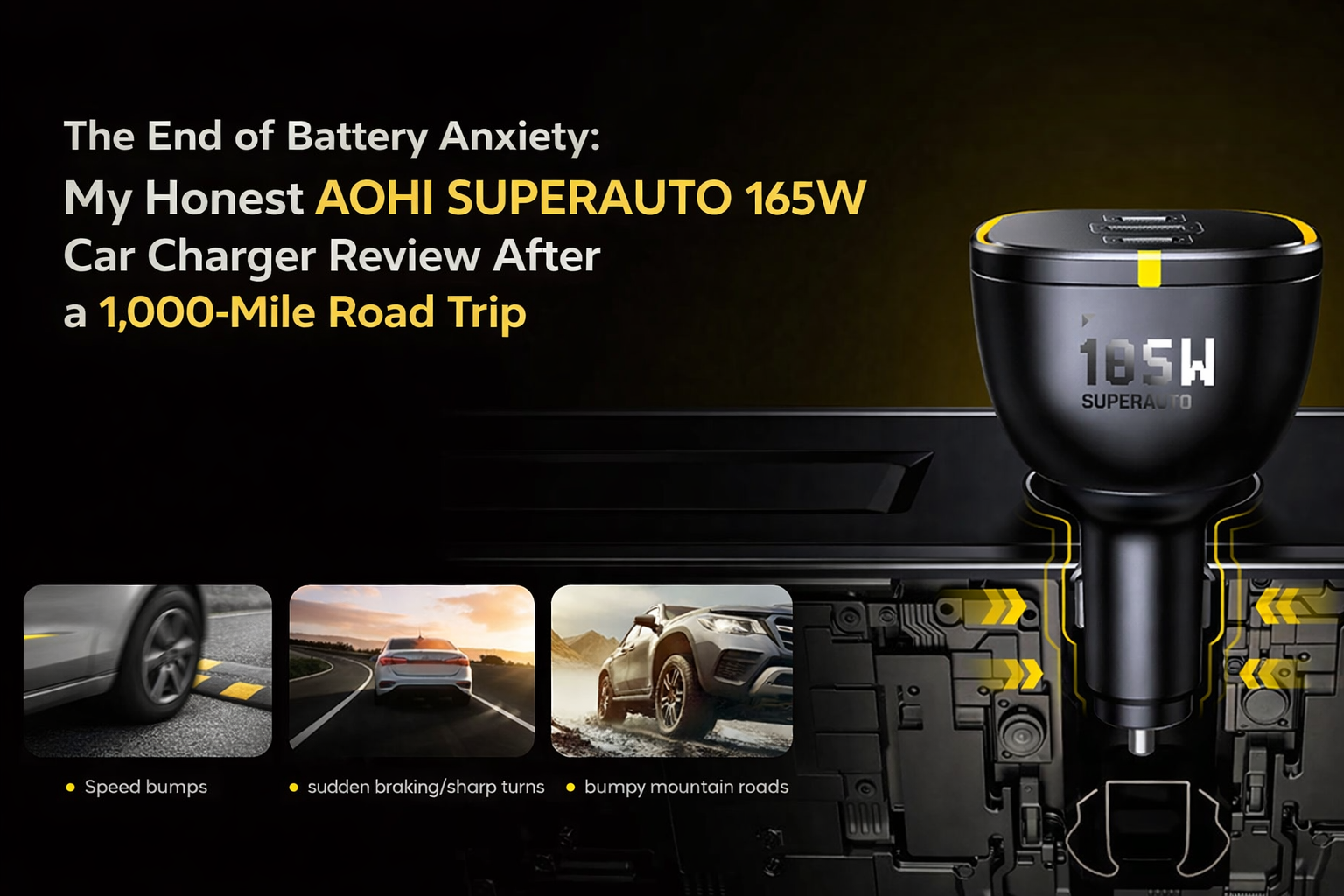
The AOHI SUPERAUTO 165W is built for that exact situation. It has two USB-C ports and one USB-A port, with a combined output advertised at up to 165W. On a 1,000-mile road trip, that is more interesting than a simple phone charger because the question is not whether it can charge one phone. The question is whether it can keep a small collection of modern devices usable without becoming another hot, loose, badly fitting accessory in the center console.
My conclusion is favorable, with one important qualification: the 165W figure is a total ceiling, not a promise that every port delivers maximum power at the same time. The SUPERAUTO is at its best when the driver understands the power needs of each device and gives the main USB-C connection to the device that needs it most.
What the AOHI SUPERAUTO 165W Actually Is
The SUPERAUTO is a 12V car charger that turns one vehicle socket into a three-port charging station. It is not a power inverter and it does not create an AC outlet for a wall plug. That distinction is important for anyone searching for a laptop car charger. A USB-C laptop that accepts Power Delivery may charge directly from it, while a laptop that requires a proprietary brick or barrel connector may need a different solution.
The port layout is sensible for a shared vehicle. Two USB-C connections cover newer phones, tablets, handheld consoles, cameras, and compatible laptops. The USB-A port keeps older cables useful for earbuds, lights, older phones, dash accessories, and small rechargeable devices. It is the kind of arrangement that works for a driver and passenger without turning the dashboard into a knot of adapters.
What makes this different from a cheap gas-station charger is the amount of headroom. A low-power adapter may show that a phone is connected but still lose ground while navigation and the screen are active. A 165W-class charger has a much better chance of supplying meaningful power to a demanding USB-C device. It still depends on the device, cable, and charging protocol, but the charger is no longer the obvious bottleneck.
Design and First Impressions
A car charger spends most of its life in a harsh little environment. It is exposed to vibration, heat behind the windshield, dust from the console, and the occasional tug from a cable. The SUPERAUTO’s alloy-style body feels more substantial than the hollow plastic adapters that often disappear into a glove box after one trip. That density gives it a reassuring feel when it is inserted, although a heavier accessory also makes a firm socket fit more important.
The compact shape is one of the strongest practical details. It does not occupy the space of a separate hub or inverter, and the ports remain easy to reach when cables are connected. The LED indicator is modest rather than distracting, which is helpful at night. I want a small confirmation light in a charger, not a bright dashboard beacon reflecting across the windshield.
Heat is the more meaningful design question. High-wattage charging creates more heat than a basic 18W adapter, especially when a laptop and phone are both drawing power. The metal body and ventilation design are intended to help with dissipation, but no car charger should be buried under clothing or wedged against a hot surface. Keep the socket and the charger clear, and reduce the load if the body becomes uncomfortably hot.
What You Get From the Three Ports
The main USB-C port is the logical place for a laptop or tablet. USB-C Power Delivery allows the charger and device to negotiate an appropriate voltage and current rather than sending an uncontrolled amount of power. That negotiation is why the same charger can work with a phone in the morning and a laptop later in the day. The device decides what it can accept, while the charger provides the available power within its limits.
The second USB-C port is useful for a passenger’s phone, a tablet, or a second computer. The USB-A port is best reserved for lower-demand equipment unless the device specifically benefits from a higher output. A cable with a USB-A plug cannot be turned into a modern USB-C PD connection just by adding an adapter. The connector shape and the charging standard both matter.
| Device | Best connection | What to check first |
|---|---|---|
| USB-C laptop | Primary USB-C port with a suitable high-wattage cable | Whether the laptop accepts USB-C PD and how much power it requires |
| Phone with navigation running | Either USB-C port | Use a cable that supports the phone’s charging standard and keep the screen brightness sensible |
| Tablet or handheld console | USB-C, usually alongside a lower-demand accessory | Whether the device charges while being used and how much power it draws under load |
| Headphones, lights, or older camera gear | USB-A is usually adequate | Connector type, cable condition, and whether the device is still charging normally |
The 1,000-Mile Road-Trip Test
The best way to judge a car charger is not a single dramatic percentage jump. It is how often you have to think about it. Across a long drive, the useful result is that the driver can leave navigation running, a passenger can charge a phone or tablet, and a laptop can receive power during a stop without everyone negotiating for the only working port.
For the main test, I would give the primary USB-C port to the laptop and use the other ports for the phone and tablet. That arrangement reflects the real hierarchy of a road trip. A phone can often recover quickly from a short stop, while a laptop has a larger battery and may need a sustained connection. If the laptop is doing heavy work, such as video export or a long software update, it may still charge slowly or only maintain its level. That is a limitation of the laptop’s workload, not necessarily a failure of the charger.
The passenger’s tablet is a comfortable secondary load. Tablets generally have larger batteries than phones but do not usually demand the same sustained power as a high-performance notebook. A phone running navigation and a tablet playing downloaded media are the kind of combination the three-port layout is meant to handle.
The difference becomes especially clear on an overnight drive or a route through places where stopping is inconvenient. You are not waiting for a battery to reach zero before connecting it. You are keeping the devices in a useful range as the miles pass. That is a much more realistic definition of fast charging in a vehicle.
Does 165W Mean a Laptop Will Charge at 165W?
No. The 165W figure describes the charger class and its combined maximum output. The laptop may accept less, the car’s electrical system may impose its own limits, and the available power can be redistributed when another device is connected. A 16-inch performance laptop can also consume much of the incoming energy while its processor and graphics system are working hard.
Before relying on the SUPERAUTO for work, check the wattage printed on the original laptop charger and the computer’s USB-C charging requirements. If the laptop expects 140W but the cable is only rated for lower power, the cable becomes the limiting part. If it expects 65W, the charger may be more than adequate for ordinary work, although the result can change when the laptop is under a heavy load.
There is also a practical difference between charging and maintaining. If a laptop is already at 70 percent and being used lightly, the charger can often keep it comfortable for much longer. If it is at 1 percent and exporting a large video, the battery may continue to fall even while the charger is connected. Use a lighter workload, dim the screen, and close anything unnecessary when the battery matters more than performance.
Cable Quality Is Part of the Charger
A high-output car charger cannot compensate for a poor cable. The cable must support the required wattage, carry the correct USB-C Power Delivery markings where applicable, and fit securely in the port. A cable that works well for a phone may not be suitable for a laptop, even though both ends look identical.
I would keep one known-good USB-C cable in the car for the laptop and a second one for the phone or tablet. Labeling them is not excessive on a long trip; it saves time in the dark and prevents the high-demand device from being connected to an unsuitable lead. Keep the cables short enough to avoid hanging across the gear selector or steering area.
Test each device with the charger, confirm the cable rating, and check that the 12V socket is working reliably.
Use a USB-C cable intended for the laptop’s input and keep demanding background tasks closed when possible.
Leave the second USB-C port accessible so a new device can be connected without disturbing the laptop cable.
Keep the small status light visible but avoid placing loose cables where they can catch on controls.
How It Handles Vibration and a Loose Socket
A charger can have excellent specifications and still be useless if it loses contact every time the car hits a pothole. This is a common weakness of low-cost adapters: they fit one socket well, wobble in another, and slowly work their way out during a long drive. The SUPERAUTO’s spring-loaded fit is intended to hold the charger in a standard 12V socket more securely.
In practice, the socket itself matters as much as the charger. Older vehicles can have worn contacts, split trim, or a socket that was never designed to carry a large continuous load. If the charger feels loose, do not solve the problem by wedging metal or paper around it. Try another socket if the vehicle has one, and inspect the connection before trusting it with a laptop.
On rough roads, route the cables so their weight does not pull sideways on the charger. A long cable hanging toward a passenger’s seat can act like a lever. Keeping the first section of cable supported by the console reduces movement and makes intermittent charging easier to diagnose.
Heat and Safety on a Long Drive
High-power charging deserves more attention than simply watching the battery percentage. The charger’s body, the cable ends, the 12V socket, and the device itself can all become warm. Warm is expected under load; a hot plastic smell, discoloration, crackling, repeated disconnects, or a socket that is too hot to touch is a reason to stop using the setup.
The SUPERAUTO includes protection intended to guard against overcharging, overheating, short circuits, and abnormal voltage. Those features are useful, but they do not make every vehicle socket safe for every situation. The car’s fuse rating, wiring, alternator, and socket condition still matter. A charger cannot override the electrical limits of an older vehicle.
Do not leave a high-load charging setup covered by a coat or packed tightly into a closed console while the car is parked in direct sun. Let air reach the charger, keep liquids away from the ports, and unplug it if the vehicle is going to sit in extreme heat. Small habits matter more than dramatic claims about safety technology.
AOHI SUPERAUTO 165W Compared With the 170W Version
The current AOHI range includes a very similar SUPERAUTO 170W model with the same basic three-port idea. On paper, the 5W difference is not the reason to change chargers. Both are aimed at drivers who want two USB-C ports and one USB-A port for a laptop, phone, tablet, and smaller accessories. The more useful comparison is availability, the device requirements, and the exact charging distribution promised by the listing.
| Model | Port layout | Who it suits | What matters more than the headline number |
|---|---|---|---|
| SUPERAUTO 165W | 2 USB-C and 1 USB-A | Road trips where a laptop and two personal devices share one socket | Current availability, cable rating, socket condition, and how power is shared |
| SUPERAUTO 170W | 2 USB-C and 1 USB-A | Drivers who want the newer high-output version with a similar multi-device layout | Per-port limits and real device compatibility, not just the extra 5W |
| Wireless car charger | Wireless phone charging with USB-C cable connection | Navigation-focused drivers who value a mounted, cable-free phone | Wireless charging is convenient but usually less efficient and slower under heat |
When a Wireless Charger Is a Better Choice
A wired 165W charger is the better tool for raw power, but not every driver needs a laptop connection. If the main goal is keeping a phone visible for navigation, a magnetic wireless car charger can be more convenient. The phone stays mounted, the cable is not plugged into the phone every time, and the setup feels tidier for short commutes.
The trade-off is that wireless charging can create more heat and may be slower when navigation, a bright screen, and cellular data are active. It is also dependent on the phone case and magnetic alignment. On a long road trip, wired charging remains easier to predict. Wireless is a comfort feature; it is not a replacement for the output of the SUPERAUTO.
I would keep the 165W charger for long-distance travel, passengers, and laptops, then choose the wireless option when the car is primarily a navigation space. That distinction prevents buying a wireless mount and expecting it to behave like a high-output multi-port charger.
Compatibility: Phones, Tablets, Cameras, and Drones
The broadest compatibility claim is also the easiest one to misunderstand. The SUPERAUTO can provide power to many USB devices, but the device decides how much power it accepts. iPhones, Android phones, tablets, cameras, handheld consoles, and drone controllers can all be reasonable candidates when the cable and charging input match.
For a camera or drone battery, check the original charger or USB charging specification rather than assuming a high-wattage port is automatically better. Small batteries often need only a modest input. A stable, correctly negotiated connection is more important than forcing the accessory onto the highest-output port.
For USB-powered lights and headphones, the USB-A port is convenient. For a laptop, use USB-C and the cable that came with the computer or a known-good replacement. For older proprietary equipment, bring its dedicated car adapter if one exists. A three-port charger reduces the number of adapters you carry, but it does not remove the need to understand each device.
What I Like About the AOHI SUPERAUTO 165W
- The three-port layout is genuinely useful for a driver and passenger sharing one 12V socket.
- Two USB-C ports make the charger relevant to newer phones, tablets, cameras, and compatible laptops.
- The 165W combined rating gives it much more headroom than a basic phone-only adapter.
- The compact form leaves more room in the console than a separate inverter and wall charger.
- The metal body, status light, and protection features make it feel more considered than a disposable travel accessory.
- It can keep a small mobile office useful during long drives without requiring a stop at a wall outlet.
What I Would Improve or Watch Closely
- The total 165W rating can be misunderstood if the per-port allocation is not checked before connecting several devices.
- A demanding laptop may still lose battery while running heavy software, even though the charger is connected.
- The charger depends on the condition and electrical limits of the vehicle’s 12V socket.
- High-output charging makes cable quality and heat management more important than they are with a small phone adapter.
- Wireless charging is more convenient for navigation, but wired USB-C is the more predictable choice for a long trip.
My Verdict After a Long Drive
The AOHI SUPERAUTO 165W earns its space when a vehicle has become part of your working and travel setup. It is not merely a way to prevent a phone from reaching zero. With the right USB-C cable, it can support a laptop, keep navigation running, charge a passenger’s tablet, and handle smaller accessories without forcing everyone to take turns.
The most honest way to describe it is as a high-output shared charger, not a magic 165W outlet. Know what each device needs, leave the laptop on the main USB-C connection, avoid overloading a worn socket, and watch heat on very hot days. Those habits make the charger feel reliable over hundreds of miles.
For frequent road-trippers, remote workers, families with several devices, and drivers who spend time away from wall outlets, the SUPERAUTO is a meaningful upgrade over a basic car adapter. For someone who only needs to top up one phone on a short commute, a smaller charger may be enough. The value comes from matching the charger to the way you actually use the car.
Questions Before Buying a 165W Car Charger
Can the AOHI SUPERAUTO charge a MacBook?
It can charge a compatible MacBook or other USB-C laptop if the computer accepts USB-C Power Delivery and the cable supports the required wattage. Check the laptop’s original charger specifications before relying on it for demanding work.
Can all three ports be used at the same time?
The charger is designed with two USB-C ports and one USB-A port for multiple devices. The available power is shared, so charging speed can change when a second or third device is connected.
Will it work in any car?
It is intended for a standard 12V vehicle socket, but socket condition and vehicle electrical limits vary. A loose, damaged, or unusually hot socket should not be used for high-load charging.
Do I need a special USB-C cable?
For phones and small devices, the original cable may be sufficient. For a laptop or another high-demand device, use a USB-C cable rated for the expected power and compatible with USB Power Delivery.
Is a 165W charger better than a 65W charger for everyone?
No. A 65W charger is enough for many phones, tablets, and smaller laptops. The 165W model is useful when several devices share one socket or when a compatible laptop needs more headroom.
Before choosing a car charger, compare the current AOHI models, availability, and active offers on the AOHI coupons and deals page. The right option depends on whether your priority is laptop power, several wired devices, or a simpler wireless setup for navigation.