KuKirin G4 Ultra Review Before You Buy: Real Range, Top Speed, Weight, Charging Time, and US Street-Legal Limits
KuKirin has added a new name to its performance lineup: the G4 Ultra. On paper, it is the sort of scooter that is difficult to scroll past. Two 1000W motors, a 60V 20Ah battery, 11-inch tubeless tires, and a claimed 43.5 mph top speed put it well beyond the familiar last-mile commuter. But an exciting specification sheet can also hide the questions that matter after the box arrives. We compared KuKirin’s published figures, launch material, and early community discussion, then looked at the recurring lessons shared by owners of the older G4 platform. The result is a buyer-focused review of what looks promising, what remains uncertain, and what deserves a careful check before the first serious ride.
Our early verdict: the G4 Ultra has the ingredients of an entertaining, muscular scooter for an experienced rider with suitable private riding space. It is much harder to recommend as an effortless daily commuter. Depending on which regional figure proves correct, it weighs roughly 83 to 97 lb, uses mechanical disc brakes, and carries only an IPX4 splash-resistance rating. The headline range is also a best-case figure rather than a promise of 49.7 miles at full speed. In other words, the G4 Ultra may be exciting for the right owner, but it rewards a careful buyer far more than an impulsive one.
What kind of scooter is the KuKirin G4 Ultra?
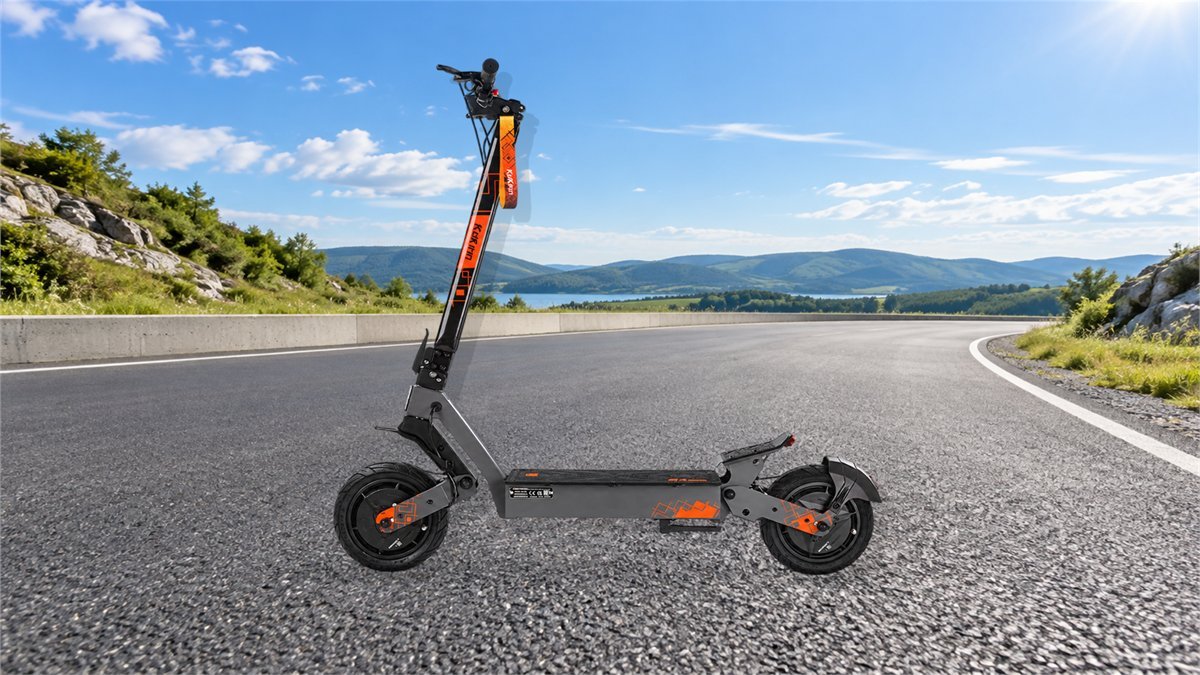
The easiest way to understand the G4 Ultra is to forget the folding stem for a moment. This is not a lightweight scooter meant to be carried onto a train or tucked under an office desk. Its long deck, dual-motor drive, large battery, and motorcycle-like speed place it closer to a compact recreational vehicle. The table below translates the sales-page numbers into the questions a rider is likely to ask after the excitement of the first glance wears off.
| Feature | Published specification | How it may feel in everyday use |
|---|---|---|
| Motor system | Front and rear 1000W brushless motors; 2000W combined rated output | All-wheel drive should improve launch and climbing traction, but independent acceleration and thermal tests are not yet available. |
| Battery | 60V, 20Ah, approximately 1,200Wh | Large enough for meaningful distance, but not exceptional for a scooter approaching 100 lb with two motors. |
| Speed modes | 20, 40, and 70 km/h | Approximately 12.4, 24.9, and 43.5 mph. Even the middle mode can exceed local e-scooter limits. |
| Claimed range | Up to 80 km ECO, 50 km SPORT, and 35 km RACE | Approximately 49.7, 31.1, and 21.7 miles under unspecified or lightly described test conditions. |
| Charging | 5-6 hours; one listing specifies a 67.2V 5A charger | Reasonable for 1,200Wh if the delivered charger is genuinely 5A. Verify the label because another regional table displays a conflicting charger entry. |
| Tires | 11-inch tubeless or “vacuum” tires; 50 psi listed by one current page | Tubeless tires reduce pinch-flat risk, but pressure remains critical for range, heat, steering feel, and stability. |
| Brakes | Front and rear 160mm mechanical discs with motor power cut-off | Mechanical brakes are serviceable, but cable tension, pad clearance, rotor condition, and lever feel need routine inspection on a fast scooter. |
| Suspension | Front and rear spring suspension | Useful on broken pavement, although spring rate, damping, bottoming resistance, and behavior under braking remain untested independently. |
| Water resistance | IPX4 | Protection from splashing, not permission to ride through deep water, use a pressure washer, or charge a wet scooter. |
| Maximum load | 120 kg / 265 lb | The rating includes the rider, backpack, lock, tools, and any cargo. Near-limit use may reduce range and climbing speed. |
| Dimensions | 52.8 x 25.6 x 50.2 in unfolded; 52.8 x 25.6 x 22.1 in folded | Folding reduces height but not length or width. Measure the car trunk, elevator, and storage space before ordering. |
| Published weight | 82.9 lb on one listing; 95.7-97.0 lb on others | A 12-14 lb discrepancy is too large to ignore. Ask for the shipping label or exact regional specification before assuming it is portable. |

Realistic range: why riding mode changes the story
The number most people notice first is 80 km, or about 49.7 miles. Read a little further, however, and the story becomes more interesting. KuKirin separates its estimate by riding mode: up to 80 km in ECO, 50 km in SPORT, and 35 km in RACE. That spread makes sense. A scooter moving gently through a flat route asks far less of its battery than the same machine repeatedly launching both motors and pushing against the air at higher speed.
The battery holds roughly 1,200Wh on paper. Dividing that figure by the three claimed distances gives about 15Wh/km in ECO, 24Wh/km in SPORT, and 34Wh/km in RACE. Those numbers are not an independent range test, but they illustrate how quickly extra speed can consume the reserve. A rider who buys the G4 Ultra for its performance should expect a very different afternoon from someone who spends most of the trip in ECO.
Variables that can cut the achieved distance
- Speed: holding 40-70 km/h creates much more aerodynamic load than a steady 20 km/h test.
- Rider and cargo weight: acceleration and hills cost more energy as total mass rises.
- Temperature: cold cells deliver less usable energy and can feel weaker under high current.
- Tire pressure: underinflated tires add rolling resistance, heat, vague steering, and rim-impact risk.
- Stops and hills: repeated launches and long climbs can use more energy than a flat continuous route.
- Wind and surface: headwinds, gravel, grass, and soft ground all shorten a road-based estimate.
A smarter first ride: learn the scooter before chasing speed
A new performance scooter invites curiosity, but the first outing is more useful when it feels like an introduction rather than an audition. Choose a short loop that passes your starting point several times. That gives you room to notice how the throttle arrives, whether the steering stays calm, how both brakes feel, and how quickly the battery display changes without turning the ride home into a calculation.
About that 43.5 mph top-speed claim
Forty-three miles per hour sounds thrilling when it is printed beside two motors. From the deck of a scooter, it is a much more serious number. At that pace, small details become large ones: tire balance, steering play, loose fasteners, brake adjustment, rider stance, and a patch of broken pavement can matter more than the motor badge.
The three modes give the G4 Ultra a gentler side. ECO is limited to about 12.4 mph, while SPORT reaches roughly 24.9 mph before RACE unlocks the headline figure. These modes are useful for learning the throttle and preserving range, but they do not make the scooter lighter or shorten its stopping distance. Think of them as different personalities of the same heavy machine, not as a substitute for setup and judgment.
What early discussions and older G4 owners teach us
Long-term G4 Ultra ownership stories are still scarce, so it would be misleading to borrow every complaint or compliment from the older G4 and attach it to the new model. The Ultra has a different drive layout and may differ in its frame, electronics, and regional configuration. Still, the older community has spent enough time with heavy KuKirin scooters to reveal a useful pattern: the best ownership experience often begins with careful setup, realistic range expectations, and attention to ordinary wear items.
| Older G4 discussion theme | What owners reported | Reasonable G4 Ultra response |
|---|---|---|
| High-speed steering feel | Reports conflict: some riders describe wobble, while others report stable riding at similar speeds. | Check tire pressure, wheel runout, steering play, fastener condition, rider stance, and alignment before increasing speed. Do not assume either outcome applies automatically to Ultra. |
| Mechanical brakes | Several owners discuss cable adjustment, pad wear, rotor rub, and replacement pads. | Bed in the brakes, inspect both calipers, learn pad-adjustment procedure, and judge lever travel before relying on maximum performance. |
| Loose hardware and noise | Some threads mention steering or suspension fasteners loosening and new noises appearing with use. | Perform a documented arrival inspection and scheduled bolt checks using the correct manual and torque values. |
| Heavy handling | The older G4 is praised for planted cruising but criticized by some lighter riders for awkward balance and turning effort. | The heavier dual-motor Ultra should be treated as a ground-level vehicle, not something to carry daily up stairs. |
| Range versus speed | Owners generally report strong range at moderate pace and a large reduction when ridden hard. | Expect the Ultra’s mode-based claims to separate the same way until exact independent tests show otherwise. |
Forum posts naturally contain more problems than quiet, uneventful rides, while storefront reviews often capture the excitement of the first week. Reading both is still valuable when the same practical themes return: tire pressure, brake adjustment, fastener checks, wheel alignment, and the effect of speed on range. None of that proves the Ultra will develop a fault. It simply shows where an attentive owner should look first.
When the box arrives: give the G4 Ultra a proper introduction
Unboxing a scooter like this should feel less like opening a toy and more like taking delivery of a small vehicle. Before removing every piece of packaging, photograph the carton and serial label. Then take a slow walk around the scooter. Shipping pressure can reveal itself as a bent rotor, a loose clamp, a damaged cable, or a tire that no longer sits evenly on the rim. Finding that in the garage is far better than discovering it under acceleration.
Receipt-day checklist
- Confirm the carton, frame label, and order all identify G4 Ultra.
- Weigh the scooter if portability matters; published values conflict by more than 12 lb.
- Read the tire sidewall and delivered manual before using the online 50 psi figure.
- Inspect both tires for bead seating, cuts, deformation, and shipping pressure.
- Check axle hardware, suspension pivots, handlebar clamp, stem, and folding latch.
- Lift each wheel and check for lateral runout, bearing roughness, and persistent rotor contact.
- Squeeze each brake lever firmly and verify that motor power cuts when braking.
- Confirm the throttle snaps back freely with the handlebar turned both directions.
- Verify lights, brake light, horn, indicators if fitted, display, keys, and every speed mode.
- Check the charger label for voltage, current, plug, and regional input compatibility.
- Test at walking speed, then low speed, before adding power or rough terrain.
- Record any noise, error code, heat, pull, vibration, or brake inconsistency on video.
The weight question is more important than it looks
One regional page lists 37.6 kg, or about 82.9 lb, while others place the scooter at roughly 95.7 to 97 lb. That is not a harmless rounding error. It can decide whether one person can lift the G4 Ultra into a trunk, whether an apartment staircase becomes a daily obstacle, and whether the folded scooter fits the way you imagined. The stem folds, but the 52.8-inch length and 25.6-inch width remain. This is a scooter that prefers a garage, elevator, or ground-floor storage space.
The brakes deserve more attention than the motor numbers
KuKirin publishes an 8-12 meter braking figure, but the number arrives without the context needed to judge it. Eight meters from 12 mph is one experience; eight meters from 43 mph is another. Rider weight, road surface, tire temperature, brake setup, and starting speed all change the result.
The G4 Ultra uses front and rear 160mm mechanical discs with motor cut-off switches. That is a familiar, serviceable arrangement, although it asks the owner to pay attention to cable tension and caliper alignment as the parts bed in. The first test should be quiet and progressive: learn where each lever begins to bite, confirm that both motors stop driving, and listen for rubbing or grinding before adding speed.
Healthy behavior
- Predictable lever travel without reaching the grip
- Both wheels decelerate progressively
- No strong pull to one side
- No loose caliper, cracked mount, or contaminated rotor
- Motor power stops as soon as either brake switch activates
Reasons to stop testing
- Lever suddenly changes position or feels spongy
- Grinding, pulsing, or severe rotor rub
- Wheel, axle, stem, or suspension play
- Throttle remains active while braking
- Repeated wobble after pressure and hardware checks
Living with the battery: charging time and everyday care
A 60V 20Ah battery stores roughly 1,200Wh, enough energy that charging becomes part of the ownership routine rather than an afterthought. KuKirin advertises a 5-6 hour charge, which is plausible with the 67.2V 5A charger shown on one regional specification page. Another page lists a different charger figure, so the label on the unit that arrives at your door is the one to trust.
We could not verify an exact-model UL 2272 record in the material available during this review. That is not the same as saying the scooter has no certification, but it is worth asking for the certification body, standard, report number, exact model name, and matching label. A certified charger or battery component does not automatically certify the complete scooter.
Rain, puddles, and what IPX4 really means
IPX4 sounds reassuring until it is translated into everyday riding. It means resistance to splashing under a controlled test, not freedom to cross deep puddles, wash the scooter with a hose, or leave it charging while moisture sits around the port. The faster the scooter moves, the more forcefully water can reach cable entries, bearings, the display, controller enclosure, and motor connections.
- Avoid water deep enough to reach the deck, hubs, cable entries, or charging port.
- Reduce speed on wet surfaces; 11-inch tires do not eliminate reduced grip or longer braking.
- Do not open the charging port outdoors in rain or connect the charger while moisture remains.
- After an unexpected splash, power down, wipe the scooter, inspect exposed ports, and let it dry before charging.
- Water damage may be excluded from warranty even when an IP rating is advertised; read the current terms.
Can you legally ride the KuKirin G4 Ultra in the USA?
This may be the least exciting part of the buying decision, but it can determine where the scooter is useful. The United States has no single rule that makes a 43.5 mph scooter legal everywhere. States and cities define electric scooters differently and may regulate design speed, riding speed, motor output, helmets, licensing, sidewalks, bike lanes, and public roads.
Two examples show why the location must be checked before purchase. California DMV says a motorized scooter may not exceed 15 mph and may not be operated on a sidewalk. New York City states a 15 mph limit for e-scooters as of October 24, 2025. The G4 Ultra’s claimed 43.5 mph maximum is almost three times that riding limit.
Using ECO mode can reduce selected speed, but a software setting does not automatically change how a jurisdiction classifies a vehicle built and sold with much higher capability. Check the current state statute, city rules, allowed road type, and insurance position for the exact location. A seller’s ability to ship a scooter is not proof that it may be ridden on public roads after delivery.
Who should consider the G4 Ultra?
The G4 Ultra makes the most sense when its weight and speed are advantages rather than inconveniences. Picture where it will sleep, how it will be moved, and where it can be ridden before deciding whether the performance is genuinely useful to you.
A reasonable match
- Experienced performance-scooter rider
- Legal private riding area or clearly permitted local use
- Ground-floor storage and a suitable vehicle rack or cargo area
- Willingness to inspect brakes, tires, fasteners, and bearings
- Preference for dual-motor traction over maximum battery capacity
- Comfort waiting for independent range and durability evidence
Look elsewhere or wait
- Daily stairs, bus or train transfers, or frequent lifting
- Wet-weather commuting as a requirement
- Need for a proven exact-model owner history
- Need for a confirmed local warehouse or exact-model UL documentation now
- Expectation of 49.7 miles at high speed
- Preference for hydraulic brakes with less cable maintenance
The final questions to ask before ordering
By this point, the appeal of the G4 Ultra is easy to understand. The final decision comes down to details that rarely fit into a dramatic product photo. Ask which warehouse will ship the scooter, what the delivered weight will be, which charger and plug are included, who handles the warranty, where a return must be sent, and whether replacement tires, pads, and electrical parts are readily available. Keep those answers with the order confirmation.
When the scooter arrives, resist the urge to throw away the packaging after a quick power-on test. Give yourself time to inspect the hardware, charge it safely, run both wheels at low speed, bed in the brakes, and complete a short controlled ride. If the weight, charger, tire size, frame condition, or motor behavior differs from what was promised, it is much easier to solve while the box and written return terms are still close at hand.
If the G4 Ultra still fits the way you plan to ride, you can compare current KuKirin Scooter coupon codes, electric scooter deals, and tracked prices before ordering. Price matters, but the right warehouse, charger, warranty, and return route are part of the value too.
Frequently asked questions
What is the real range of the KuKirin G4 Ultra?
No trustworthy independent exact-model range test is available yet. KuKirin currently claims up to 80 km or 49.7 miles in ECO, 50 km or 31.1 miles in SPORT, and 35 km or 21.7 miles in RACE. Rider mass, speed, acceleration, temperature, hills, wind, surface, tire pressure, and usable battery capacity can reduce the achieved distance.
How fast is the KuKirin G4 Ultra?
The published speed modes are 20, 40, and 70 km/h, equivalent to approximately 12.4, 24.9, and 43.5 mph. These are manufacturer figures. Legal riding speed can be much lower, and an independent top-speed test of the retail G4 Ultra has not yet established repeatability or stability.
How much does the G4 Ultra weigh?
Current regional specifications conflict. One lists 37.6 kg or 82.9 lb, while others list 43.4-44 kg or approximately 95.7-97.0 lb. Ask for the exact regional model’s net weight or shipping label and weigh the delivered scooter if lifting or storage is important.
How long does the G4 Ultra take to charge?
The current claim is 5-6 hours. One specification lists a 67.2V 5A charger, while another regional table contains a conflicting charger entry. Use only the supplied compatible charger and confirm its label before relying on the advertised time.
Does the G4 Ultra have hydraulic brakes?
The current specification lists front and rear 160mm mechanical disc brakes with motor power cut-off, not hydraulic brakes. Cable adjustment, pad condition, rotor alignment, and lever travel therefore belong on the maintenance checklist.
Can the KuKirin G4 Ultra be ridden in rain?
It is listed as IPX4, which is limited splash resistance rather than immersion protection. Avoid deep water, pressure washing, wet charging, and treating the rating as permission for routine heavy-rain use. Wet surfaces also reduce grip and increase stopping distance.
Is the G4 Ultra legal on US streets?
Legality depends on state and local definitions and restrictions. California and New York City both provide examples of 15 mph e-scooter limits, far below the G4 Ultra’s claimed 43.5 mph maximum. Check the current law for the exact city, road, bike lane, or property before buying.
Is the KuKirin G4 Ultra worth buying now?
It can make sense for an experienced rider with legal private riding access, ground-level storage, and tolerance for early-model uncertainty. Buyers who need proven range, a confirmed local warehouse, consistent published weight, or established long-term reliability may prefer to wait for independent testing and a larger body of owner experience.
Safety, legal, and owner-discussion references
- KuKirin: G4 Ultra official unboxing and physical configuration
- ChinaPlanets: independent test of the older G4 platform
- ElectricScooters community: conflicting older-G4 stability reports and tire-pressure discussion
- ElectricScooters community: older-G4 steering, alignment, and fastener troubleshooting
- KuKirin community: older-G4 mechanical brake adjustment and pad discussion
- US Consumer Product Safety Commission: micromobility battery charging safety
- CPSC: warning about unapproved universal micromobility chargers
- UL Solutions: how to distinguish complete-device certification from component claims
- California DMV: motorized scooter definition and 15 mph limit
- NYC311: current New York City e-scooter speed rule