SIRUI BH-60 Review: Is One Tripod Head Enough for Both Photos and Video?
A still photograph and a short video can tell two different stories about the same scene. The photograph catches the arrangement of the light; a gentle pan reveals the room around it. Getting both should not require rebuilding your tripod halfway through the shoot. That is the appealing idea behind the SIRUI BH-60, a head that changes from free ball-head positioning to controlled pan-and-tilt movement.
SIRUI introduced it in October 2026 for people who regularly move between those two kinds of work. This SIRUI BH-60 review brings together its published specifications and early practical reviews to help you decide whether that convenience belongs in your own camera bag.
The short answer: the BH-60 makes the most sense for a photographer who also records interviews, travel clips or occasional moving shots. It can simplify a mixed photo-and-video kit. Choose it for that flexibility, rather than expecting the independently adjustable drag of a dedicated video head. Vertical shooters should also budget for a compatible side-mounting bracket or cage.
What the First Practical Reviews Find Useful
The most interesting early feedback is about staying with a scene instead of changing equipment. In SIRUI’s account of filmmaker Deaf Director’s hands-on review, he valued the head for traveling to interviews: establish the composition, change modes and finish framing without replacing the head. His reported camera setups included a Canon EOS R5 Mark II and a Canon C80.
That is a useful example of the intended workflow. A solo interviewer has enough to manage with sound, lighting and the conversation itself. A head that handles the portrait beforehand and the interview afterward can remove one piece of equipment from the day’s decisions.
Fstoppers reviewer Zhen Siang Yang liked the main locking control and found little settling after framing, though longer focal lengths revealed more movement. He was less satisfied with resistance during larger video tilts. That distinction is useful: a head can be convenient for mixed shooting without offering every adjustment a specialist filmmaker wants.
Long-term owner feedback is still limited. SIRUI hosts the Deaf Director summary; Yang tested the head together with SVS60 legs.
One Head, Two Different Ways of Framing
With a conventional ball head, the camera can move in several directions at once. That is convenient when you want to find a composition quickly: tilt slightly, correct the horizon, then lock the frame. During a moving video shot, however, the same freedom can let the horizon lean when you only meant to pan.
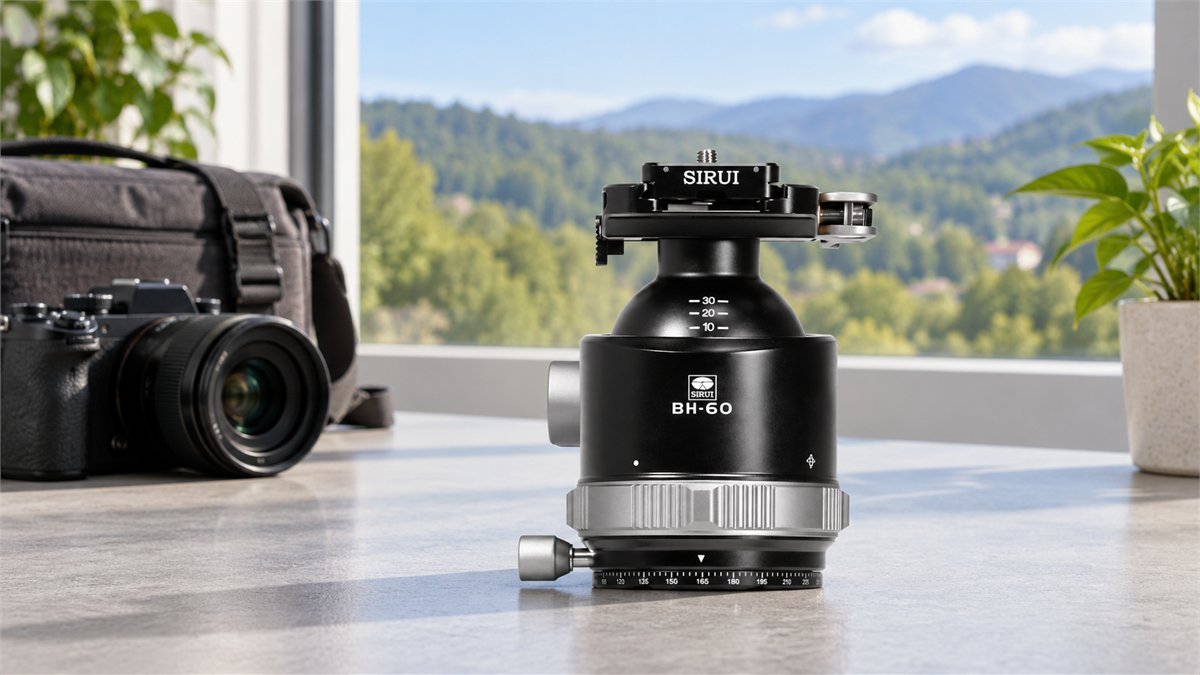
The BH-60 changes that relationship. Its selector ring offers full-motion positioning, a neutral transition position and limited-motion video operation. In video mode, sideways roll is constrained while pan and tilt remain available. The camera is still mounted on the same head; you are changing the movement it permits.
Think of a travel shoot that includes a wide landscape photograph and a short reveal across the view. The advantage is not a promise that every pan will look cinematic. It is that you can move from composing the still to practicing the moving shot without putting the camera away and unscrewing a different head.
Why the Word “Fluid” Needs a Little Context
SIRUI sells this as a ball-and-fluid head, but its published explanation describes mechanical damping without damping oil. Its pan and tilt resistance is fixed. The ball-tension control is not a pair of independent video-drag adjustments.
For a short, repeatable movement with one familiar camera setup, fixed resistance may be entirely workable. Someone changing between very light and heavily rigged cameras, or demanding a precisely tuned start and stop, has a stronger reason to choose a dedicated head with suitable drag and counterbalance controls.
The Specifications That Affect Your Camera Bag
| Detail | SIRUI specification | Why it matters |
|---|---|---|
| Head weight | 950 g, approximately 2.09 lb | Compare it with the equipment you would actually replace. |
| Video movement | 360° pan; ±40° tilt | Check whether your intended shot fits the movement range. |
| Pan and tilt drag | Fixed | Movement feel cannot be independently tuned on each axis. |
| Video counterbalance | 5 kg | A separate specification from locked static holding strength. |
| Locked photo-mode static capacity | Up to 20 kg | Not a 20 kg video operating rating or a rating for your tripod legs. |
| Quick release | Arca-Swiss-compatible; lever and safety lock | Check your actual plate’s fit and clamping tension. |
| Tripod connection | 3/8-inch bottom thread; 1/4-inch adapter supplied | Useful when retaining compatible legs you already own. |
| Control handle | 23 cm; removable; right-side mounting | Consider access around your camera’s cage and cables. |
| Head dimensions | 84 × 90 × 131 mm | Allow space in the bag as well as weight in the loadout. |
Manufacturer specifications, not our bench measurements. The pound conversion is rounded.
Will It Actually Save Weight?
Replacing two heads with one does not automatically mean a lighter bag. It depends on the two heads. Using illustrative weights, a 350 g ball head plus a 750 g video head totals 1,100 g; the 950 g BH-60 would reduce that by 150 g. If you currently carry only the 350 g ball head, the BH-60 adds 600 g instead.
Those figures are examples, not measurements of competing products. The useful calculation is your own: include the handles, quick-release adapters and any portrait bracket that would travel with you. Even when the weight difference is small, having one familiar mounting arrangement may be the more valuable improvement.
If that mixed shooting pattern sounds familiar, the BH-60 is the model to compare below. It is available as a head-only purchase, so an otherwise suitable tripod does not automatically need replacing.

BH-60 vs a Ball Head vs a Dedicated Video Head
Start with the work that earns its place in your schedule. A head that is excellent for one kind of shooting may be an unnecessary complication for another.
| Your main job | Conventional ball head | BH-60 | Dedicated adjustable video head |
|---|---|---|---|
| Mostly still photographs | Often the simplest choice; many compact options. | Worth considering when moving footage is a regular second job. | Less freedom to position across several axes at once. |
| Photos and short video on one outing | Good for stills and locked-off clips; free movement takes care. | The clearest reason to choose it: change modes without swapping heads. | Good video control, but a separate photo head may still suit your workflow. |
| Precisely repeated moving shots | Usually not the priority it was designed around. | Rehearse with its fixed resistance before committing. | Adjustable models offer more ways to match movement to the rig. |
| Frequent portrait orientation | Check for a portrait notch or use an L-bracket. | Plan a compatible side plate, L-bracket or cage. | Check the model’s portrait-mounting provision. |
| Fast changes of camera rig | Recheck balance and clamping after each change. | Check how each rig behaves with the same fixed video resistance. | A suitable adjustment range can help accommodate different rigs. |
This is a comparison of designs, not a measured contest between specific competing heads. A basic video head may have fixed drag too; look for the actual adjustments rather than assuming the word “video” guarantees them.
Matching the BH-60 to Your Camera
Think About Balance, Not Just Total Pounds
The camera’s complete working configuration matters: body, lens, battery, cage, microphone, monitor and any other attached equipment. A light body with a long lens can feel different from a heavier body with a short lens because the weight sits in a different place.
Counterbalance helps oppose the turning effect of a tilted camera. It is not a promise that every setup below a headline weight will stay at any angle with its locks released. Keep a hand on the camera when adjusting it, check the behavior of the assembled rig, and secure the appropriate locks before letting go.
For long lenses, follow the lens manufacturer’s support guidance, including use of its tripod collar where appropriate. Buying extra headline capacity is not a substitute for balancing the equipment properly or choosing legs that remain steady during the movement you need.
Arca Compatibility Is a Good Starting Point
The BH-60’s Arca-compatible platform is helpful if your camera already wears a suitable plate or L-bracket. Before a paid assignment, check the complete arrangement: plate engagement, screw security, lever clearance and access to the camera’s battery door. A plate that fits another clamp should still be checked in this one.
SIRUI provides a hex key for adjusting third-party plate tension. Make that adjustment with the camera safely supported, following the supplied instructions. The aim is a secure fit, not a lever that needs to be forced shut. If a plate cannot be secured correctly, ask SIRUI about compatibility instead of relying on extra force.
A Simple Plan for Vertical Photos and Video
Deaf Director’s review, as summarized by SIRUI, highlights the absence of a 90-degree drop notch. His suggested approach is side mounting with an appropriate cage or Arca plate. A camera-specific L-bracket is another option to assess for fit.
Choose the bracket around your camera, not just the clamp. The side mount must clear ports, cables and the screen positions you use. Mount the camera in portrait orientation and rehearse the actual shot: the handle should be reachable, nothing should snag, and the desired framing should fit the available movement.
For someone already using a compatible L-bracket, this may be an easy part of the setup. For a creator switching constantly between horizontal and vertical recording, it belongs in the buying decision from the start.
A Calm First Setup Before the Important Shoot
Give yourself time to learn the controls somewhere quiet. A living-room practice session is a better place to discover where the release lever sits than beside a waiting interview subject.
- Prepare the support. Place compatible legs on firm ground, secure their locks and check that the head is attached correctly. Follow both manufacturers’ instructions.
- Fit the camera in its working configuration. Install the lens and accessories you intend to use. Support the camera while checking plate engagement and the safety mechanism.
- Set the horizon in photo mode. Adjust the position with the camera supported. Check the horizon through the viewfinder or display, not only the small bubble level.
- Change modes gently. Yang found that the head needs to be level for the selector to engage video mode. Support the camera and do not force the ring.
- Rehearse the exact motion. Try the lens, direction and speed you plan to record. Watch the start, middle and stop of the shot on playback.
- Secure the frame for static work. Lock the necessary controls before stepping away. Keep the rig within the specifications of every supporting component.
A useful practice sequence is one still composition, one slow pan and one short tilt. Repeat it at the longer end of your zoom as well as the wide end. This is a personal fit check, not a laboratory test, but it is directly relevant to the footage you need.
When the Movement Does Not Feel Quite Right
Some adjustment is simply learning where a new control sits. Other differences are part of the design. Keeping those separate makes it easier to decide whether to keep practicing, change the setup or choose another head.
| What you notice | Useful next step | What that can and cannot change |
|---|---|---|
| Selector ring will not complete a mode change | Support the camera, check alignment and follow the mode-change instructions. | Correct positioning can allow engagement. Persistent binding warrants support, not extra force. |
| A third-party plate feels loose | Check plate compatibility and the documented clamp-tension adjustment. | Adjustment can address fit; it cannot make every plate design compatible. |
| Video resistance does not suit your shot | Check the assembled rig and rehearse within the specified movement range. | Technique can help you assess the feel, but it does not add independent drag settings. |
| The camera moves when you release a control | Keep it supported, assess balance and secure the required lock. | Counterbalance is not a substitute for locking a static frame. |
| The tripod starts to lift or tip during a tilt | Stop the move and support the camera immediately. Reassess stance and support suitability. | Do not use more handle force to overcome resistance or continue an unstable movement. |
Yang also reported that larger tilts could destabilize his support setup. This is an individual observation, but any lifting leg is a reason to stop immediately. Persistent rough motion, binding or unreliable locking after the documented checks calls for seller support or a return assessment, not disassembly or improvised lubrication.
Keep Your Existing Legs or Buy a Complete Kit?
The head-only option is attractive when you already have dependable legs with a compatible mounting connection. That lets you change the part of the system responsible for movement without replacing everything beneath it.
SIRUI also lists an AM-324S combination at approximately 2.3 kg and an SVS60 combination at approximately 3.28 kg. Those are whole-kit figures, not alternate weights of the BH-60. The difference is about 980 g, so the choice deserves attention if the tripod will be carried for hours rather than moved between a car and a shooting location.
Decide how you use the legs before paying for a bundle. Working height, folded length, footing and the ease of leveling are everyday considerations. Someone filming seated interviews may value a different arrangement from someone walking to landscape locations. A convenient head cannot compensate for legs that do not suit the job.
To compare the support around the head, browse Tripods Coupons & Deals in Cameras & Creator Gear. Compare carrying size and working height alongside the mounting connection, rather than selecting legs by load capacity alone.
Who Should Buy the SIRUI BH-60?
Put it on your shortlist if a typical outing genuinely includes both stills and moving footage. The strongest case is not an extreme specification; it is a simpler transition between two familiar jobs. A travel photographer adding short clips, an interviewer taking portraits before recording, or a small production team sharing one camera position can see the appeal.
A photographer who rarely records moving shots may be happier with a smaller conventional ball head. A filmmaker whose work depends on finely adjustable resistance, frequent rig changes or a wider tilt range should compare suitable dedicated video heads. Those are different priorities, not a judgment that one design is right for everyone.
Once the fit makes sense, compare the current head-only offer and any eligible discounts on SIRUI Coupons & Deals. Include a bracket or adapter only if your setup needs one, and confirm the seller’s current delivery estimate before scheduling the head for a job.
Frequently Asked Questions
Is the SIRUI BH-60 a good choice for travel?
It is worth considering when it replaces separate photo and video heads. At 950 g, it is not automatically lighter than a compact photo-only setup. Compare your complete carried kit, including brackets and handles.
Can the BH-60 replace a professional fluid head?
For some hybrid work, yes; not for every video requirement. Its fixed drag and movement range are the important differences. Choose a dedicated adjustable model when precise movement tuning is central to your work.
Does the 20 kg figure apply to video shooting?
No. SIRUI gives that figure for locked static use in photo mode. The video counterbalance specification is 5 kg. Neither number overrides the limits of your legs, plate or other support equipment.
Can I use it with a non-SIRUI tripod?
Potentially. Check the mounting thread, platform fit and tripod suitability. A matching thread is necessary, but the complete support also needs to remain stable with your camera and intended movements.
What should I buy for vertical shooting?
Look for a properly fitting camera-specific L-bracket or cage with a compatible side mount. Check port and screen clearance and the direction the camera faces when clamped. Do not assume any bracket will work equally well.
A More Convenient Kit, When You Need Both Modes
The BH-60 is most persuasive when viewed as a workflow choice. It keeps two kinds of camera movement in one piece of equipment, which can make a mixed shoot feel less interrupted. For the right hybrid creator, that is a useful improvement even without a dramatic reduction in bag weight. Match it to your camera, your portrait setup and the shots you actually make, then choose the support that lets you concentrate on the subject.
Sources
DiscountedSavings may earn a commission from qualifying purchases through product links.