Argendon Sandidry Pro 35C Review: Capacity, Pump Setup & Running Costs
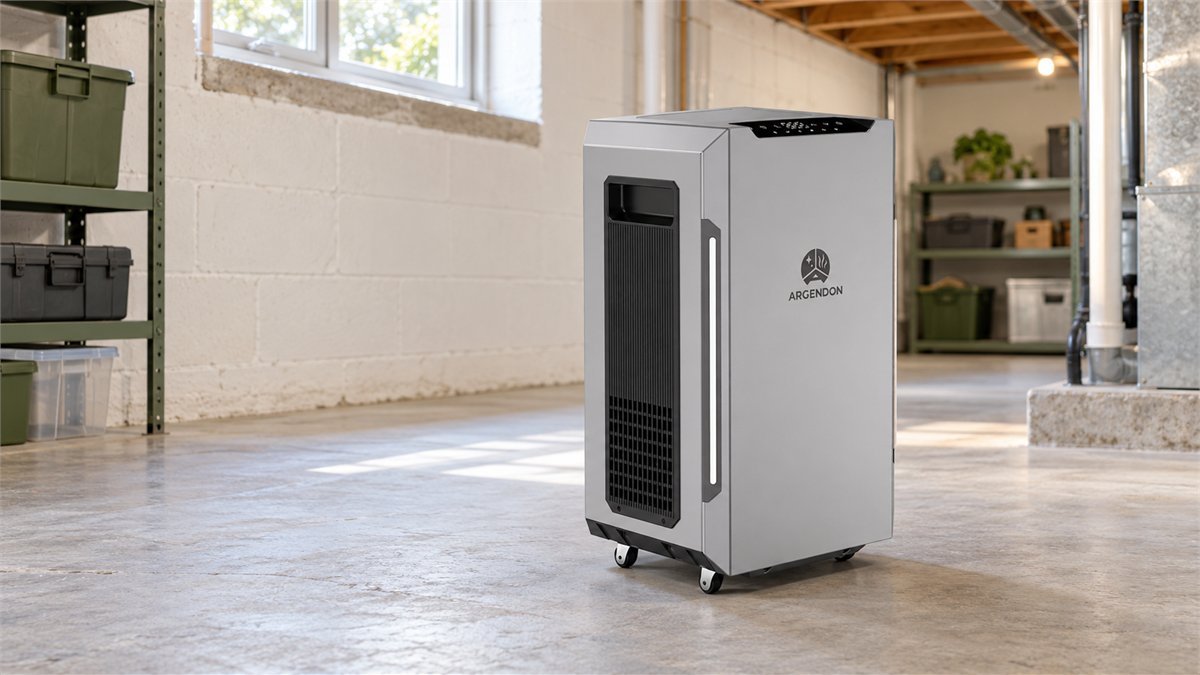
The most annoying part of a damp basement is often the routine it creates: checking the air, emptying another bucket, and wondering whether the machine is actually keeping up. The Argendon Sandidry Pro 35C tackles that routine with a built-in pump and a wheeled metal body. It looks more like utility-room equipment than something chosen to match the furniture.
That is a sensible direction for a basement appliance. But before giving it a permanent corner of the house, look past the “70-pint” headline. Its capacity ratings, drainage arrangements and service terms tell a more useful story than the biggest number on the listing.
The buying verdict: the Pro 35C is worth considering for a moderately damp, enclosed basement or utility space where pumped drainage matters. It is a less convincing choice for a severely wet space, a very low crawl space, or a bedroom where proven quietness is essential. Judge its size using comparable test ratings, not the saturation claim alone.
The detail that changes this review: 70, 35 and 21.27 pints
All three numbers appear in documentation for this model, but they do not describe the same test. Argendon specifies 70 pints per day at saturation and 35 pints at AHAM conditions. The ENERGY STAR record for Sandidry Pro35C lists 21.27 pints per day as a portable dehumidifier.
That does not mean the machine secretly changes size. Warm, moisture-heavy test air gives a dehumidifier more water to collect. ENERGY STAR explains that the newer DOE procedure tests portable units at 65°F instead of the older 80°F condition, closer to a typical basement. Consequently, a lower published rating can reflect a different test rather than a different machine.
| Figure | What it represents | How to use it |
|---|---|---|
| 70 pints/day | Argendon’s saturation rating | Do not compare it directly with a competitor’s DOE-rated capacity. |
| 35 pints/day | Manufacturer AHAM-condition rating | Useful only when the other model is rated on the same basis. |
| 21.27 pints/day | ENERGY STAR certified portable-model record | The more relevant reference for comparing current certified portable units. |
For a buyer, the consequence is simple: this is not a 70-pint DOE-rated portable dehumidifier. Nor does any rating promise that amount of water every day at home. Once the room becomes drier, less water reaching the drain may mean the machine has less work to do, not that it has stopped working.
Imagine replacing a unit that already struggles during wet weather. Choosing the Pro 35C because “70 is bigger than 35” could be an expensive misunderstanding if the two labels use different conditions. Put the test basis beside the capacity before comparing prices.
What do owner reviews establish?
Detailed, independently attributable owner reports for the exact Pro 35C remain sparse. There is not enough model-specific evidence to call a particular fault common, promise years of trouble-free service, or describe quiet operation as an owner consensus. Comments about other Argendon models are not a substitute.
That makes a sensible return window and a clear service process especially valuable. During the first days, check whether the room’s humidity falls, whether drainage stays reliable and whether the sound is acceptable from the adjacent living space. Those observations tell you more about suitability than an unrelated model’s star rating.
Where the Pro 35C makes sense, and where it does not
Argendon advertises coverage up to 1,000 square feet. Treat that as a starting point for a conversation, not a guarantee for every 1,000-square-foot basement. A mostly enclosed storage room with seasonal dampness is a different job from an equally sized room with water entering through a wall.
ENERGY STAR’s portable-unit guidance distinguishes modest dampness from very damp and wet conditions. For spaces under 2,000 square feet, its suggested ranges rise from 20-30 pints/day for slight-to-moderate dampness to 25-40 for very damp conditions and 30-50 for wet conditions. The Pro 35C’s certified capacity sits toward the smaller end of that picture.
Its better-fit customer is therefore someone trying to maintain a manageable room, with a plan for drainage and the moisture source. If humidity remains high despite continuous operation, the next purchase should not automatically be another small unit. First work out whether the problem is capacity, airflow, outdoor air entering the space, or water that needs to be stopped at its source.
Measure the route into the room, not just the floor space
The body measures approximately 12.9 × 14.14 × 24.55 inches and weighs 40.5 pounds. Wheels are helpful on a level floor, but they do not make a basement staircase disappear. Measure the doorway, hatch and final position before ordering.
The upright shape is particularly important for a crawl space. A unit can fit through the opening yet leave too little room to reach its controls, remove the filter or inspect the hose. Picture yourself doing those small jobs six months later. A slightly more convenient location may be worth more than hiding it in the farthest corner.
If the space and drainage route suit it, the Pro 35C is the model to shortlist:

The built-in pump is the feature with the clearest everyday benefit
A dehumidifier is only useful while the collected water has somewhere to go. The Pro 35C offers gravity drainage and a condensate pump. Argendon supplies a 6.5-foot gravity hose and a 19.6-foot pump hose, and advertises pumping up to 19.6 feet vertically.
A nearby floor drain favors gravity: fewer moving parts are involved in the drainage route. A higher drain can make the pump worthwhile. But hose length and vertical lift are different measurements. Before buying extra tubing or planning a long rise-and-run route, ask the manufacturer to confirm that arrangement; the headline lift is not a guarantee for every hose installation.
The manual specifies a capped gravity outlet during pump use. Hold DRAIN for three seconds to enable the pump; a brief press then starts a 28-second discharge cycle. For gravity drainage, keep the hose endpoint below its outlet.
Do the first drainage check while you are nearby. Follow the actual water route from the machine to the destination, checking for leaks and an insecure hose end. A hose that stays attached at the appliance can still cause trouble if the other end slips out of position.
What to do about an E4 drainage alarm
The manual identifies E4 as a drainage malfunction. Check external hose kinks or blockage first; a float-switch problem is another listed possibility. Persistent E4 requires support rather than repeated resets.
Before handling hoses, switch off and unplug the appliance. If water is near a plug or outlet, do not approach the wet electrical connection; isolate power safely and get qualified help. Do not bypass a float switch or improvise internal repairs to keep the machine running. Successful troubleshooting means normal drainage returns without an alarm or leak, not merely that the display temporarily clears.
Sandidry Pro 35C vs Pro 55C: is the larger model worth it?
The Pro 55C is the natural comparison if the smaller model looks marginal for the room. It occupies the same published body dimensions, so the decision is more about moisture removal, weight and power than saving a few inches.
| Specification | Sandidry Pro 35C | Sandidry Pro 55C |
|---|---|---|
| AHAM capacity, manufacturer | 35 pints/day | 55 pints/day |
| Saturation capacity | 70 pints/day | 120 pints/day |
| Advertised coverage | Up to 1,000 sq. ft. | Up to 1,500 sq. ft. |
| Listed input power | 266 W | 408 W |
| Airflow | 180 CFM | 187 CFM |
| Weight | 40.5 lb | 45 lb |
| Body dimensions | 12.9 × 14.14 × 24.55 in. | 12.9 × 14.14 × 24.55 in. |
| Drainage | Gravity or built-in pump | Gravity or built-in pump |
Manufacturer specifications checked October 23, 2026. The Pro 55C’s specification sheet and description state 55 pints at AHAM conditions; its web specification table inconsistently says 70. The comparison uses the model-specific sheet, not the conflicting table entry.
On the manufacturer’s like-for-like AHAM figures, the 55C offers roughly 57% more rated removal capacity, with about 53% more listed power. Those calculations do not establish which costs less to run in your basement: a larger machine might reach its target sooner, while an undersized one might keep working.
Choose the 35C when its capacity is appropriate and you value the lighter body and lower listed draw. Consider the 55C when you need more capacity without a larger cabinet. If your room is genuinely wet or the sizing is uncertain, get advice based on actual conditions rather than treating the next model number as an automatic solution.

How much does the Argendon Sandidry Pro 35C cost to run?
The ENERGY STAR record lists an integrated energy factor of 1.90 L/kWh and standardized annual consumption of 242 kWh. These are comparison figures, not a forecast for a continuously damp basement. At an example tariff of $0.20/kWh, 242 kWh would cost $48.40, but a long drying season can produce a very different bill.
For planning around your own routine, the manufacturer’s 266 W figure gives a simple illustration: 0.266 kW × active hours × your electricity rate. Eight active hours a day for 30 days would be 63.84 kWh, or $12.77 at $0.20/kWh. Twenty-four hours a day at that same assumed draw would be 191.52 kWh, or $38.30.
Estimate a 30-day running cost
Illustrative calculation, not measured consumption. Cycling, defrost, fan-only operation, standby and changing room conditions affect the real total. Active hours are not necessarily the hours the unit stays plugged in.
For your own estimate, multiply 0.266 by daily active hours, 30 days and your USD/kWh rate.
Use the result as a budget check, not as a prediction accurate to the cent. The useful question is whether the machine can hold an acceptable humidity without spending all day fighting a continuing moisture source. Spending less on the appliance is poor value if it cannot do the job you bought it for.
A first-week check that is more useful than watching the bucket
Start with a separate humidity meter in a representative part of the room, away from the immediate discharge. Note the temperature, humidity and weather, then look for a trend at similar times each day. A single reading beside the warm outlet is a poor description of the whole basement.
EPA advises keeping indoor relative humidity below 60%, ideally around 30-50%. An initial target around 50% is a reasonable household starting point to evaluate, rather than selecting the lowest possible setting and assuming that harder running is better. Existing leaks or mold need attention separately; drying the air does not repair a wall or remove contamination already present.
For power, the manual requires a grounded 115V/60Hz GFCI outlet and rules out extension cords and plug adapters. Keep the machine upright, level and clear of obstructions.
Check the daily routine as well as the numbers. Can someone walk past without catching the hose? Can you inspect the drain without moving stored boxes? Is the sound intrusive upstairs or in the next room? These are small details until they become the reason the appliance is switched off.
Do not mistake normal control behavior for a fault
According to the manual, the fan samples the air for three minutes each hour in off or standby mode. Continuous mode ignores the humidity target. GPP changes control to moisture content rather than relative humidity.
So if it appears to restart unexpectedly, first look at the selected mode and indicator rather than assuming the humidity sensor is broken. For ordinary household humidity control, a familiar relative-humidity target is easier to interpret than a moisture-content setting you have not deliberately chosen.
No verified model-specific noise measurement supports a “bedroom quiet” promise here. If you hear an unusual rattle, check the level surface and nearby objects; Argendon’s general support guidance identifies vibration as one possible cause. Persistent abnormal noise belongs with support, especially while you can still return an unsuitable unit.
Maintenance and warranty: the less exciting part that affects value
The manual permits vacuuming or warm-water rinsing of the filter, without cleaning agents; let it dry before reinstalling. Unplug before maintenance. Pump or internal electrical work belongs with qualified service.
Leave access to the filter and hose from day one. If cleaning requires dismantling your storage arrangement, it is much easier to postpone. The Pro 35C’s MERV-1 filter is not a reason to buy it instead of a dedicated air purifier, and an air purifier is not a substitute for controlling moisture.
The manual’s five-year coverage is limited to refrigeration-system parts, not five years of whole-unit labor. Shorter coverage periods and transport exclusions apply. Obtain the terms for your order before purchase.
Ask practical questions: who handles a claim, where the appliance goes for repair, and who pays to move a roughly 40-pound unit? Keep the receipt, serial number and packaging. A warranty is more useful when you understand the process before the machine needs attention.
Finding an Argendon discount without buying the wrong size
An Argendon discount is worth checking once the capacity and drainage suit your home. Compare the listed price, any eligible code and the final checkout total through Argendon Coupons & Deals. Do not assume a code applies to every model or combines with every sale.
The right comparison is the cost of a suitable machine, not the largest crossed-out price. A smaller discount on enough capacity can be better value than a bigger reduction on a unit that struggles through every rainy week.
Still comparing sizes or drainage options? Browse Dehumidifiers Coupons & Deals in Home Appliances and compare candidates on the same capacity-rating basis, with enough room for service access and a workable drain route.
So, is the Sandidry Pro 35C worth buying?
Its appeal is straightforward: a portable, pump-equipped machine for someone who wants controlled drainage rather than another bucket-emptying chore. The case is strongest in a moderately damp enclosed space where its certified capacity is sufficient and its upright cabinet is easy to reach.
The reasons to hesitate are equally practical: limited exact-model long-term feedback, no dependable noise figure, and the risk of overestimating capacity from the 70-pint label. If you need substantially more drying power or a low-profile installation, solve that requirement before looking for a code.
A good purchase should make the basement less troublesome, not give you a more impressive specification to worry about. Measure the space, plan the water route and compare like with like. That is where the Pro 35C either earns its place or gives way to something better suited.
Questions before ordering
Is the Pro 35C a 70-pint dehumidifier?
That is its manufacturer’s saturation rating, not its current certified portable-unit rating. The ENERGY STAR record lists 21.27 pints/day; compare that with competitors using the same test basis.
Would you choose the 35C or 55C for a basement?
Choose on moisture load, not the room name. The 35C is the smaller-capacity option. The 55C offers greater manufacturer-rated removal in the same published cabinet dimensions, but a wet basement may also need building or drainage work.
Can it replace a whole-house dehumidification system?
Do not assume that. This is listed as a portable dehumidifier. Multiple separated rooms or a ducted whole-home installation require a different sizing and installation assessment.
Is an Argendon discount code guaranteed to work?
No. Check the eligible model and offer terms, then confirm the amount in checkout before paying. A coupon is not a reason to accept unsuitable capacity, inconvenient servicing or unclear return terms.
Sources
- Argendon Sandidry Pro35C specification sheet: dimensions, power and manufacturer capacity ratings
- Argendon Sandidry Pro55C specification sheet: larger-model comparison
- Argendon Pro 35C/55C user manual: pump controls, operating modes, maintenance, alarms and warranty
- ENERGY STAR certification record 3998547: Pro35C capacity, efficiency and annual energy estimate
- ENERGY STAR: why dehumidifier test conditions and capacity labels differ
- ENERGY STAR buying guidance: capacity selection and portable versus whole-home systems
- US EPA guidance: indoor humidity, leaks and moisture-source control
- Argendon support FAQ: basic noise checks and contacting support
DiscountedSavings may earn a commission from qualifying purchases through product links.