CYCPLUS A4 Mini Air Pump Review: A Better Fit Than AS2 Pro?
A puncture is rarely the hard part of a ride until you have repaired it and still need to put the air back. That is where a small electric pump earns its place: less pumping by hand, a pressure reading you can see, and an easier restart. The CYCPLUS A4 Mini Air Pump takes that idea in a slightly different direction from the tiny AS2 Pro. It gives you a larger battery and a built-in rotating hose, rather than chasing the lowest possible pocket weight.
The short answer: A4 looks like the more practical choice for a bike bag, shared rides and riders who value battery reserve. AS2 Pro is the better fit when a small jersey-pocket package matters most. A4 weighs 210 g versus AS2 Pro’s 120 g, so the decision is really about what you want those extra 90 g to do.
A4 is still new enough that meaningful long-term owner feedback is scarce. This review therefore compares its current specifications and published inflation tests with the more established AS2 Pro, including owner accounts and an independent test of that model. A4 is not a car-tire inflator: CYCPLUS explicitly excludes that use, despite the 120 PSI headline rating.
The convenience owners actually value
The most useful theme in the AS2 Pro owner accounts is not maximum pressure. It is having a small pump ready when a tire needs attention. Matthew describes using his for roadside flats and travel; Viktor describes relying on one during a multiweek ride; Michael values being able to pack a pump with a folding bike instead of taking a floor pump. Those are AS2 Pro experiences, not proof of A4 reliability, but they explain why this category appeals to regular cyclists.
The benefit is especially easy to understand after a roadside repair. An electric pump can do the repetitive work while you watch the reading, rather than making inflation another tiring part of the stop. It also gives less mechanically confident riders a clearer target than judging a tire only by squeezing it.
There is a useful difference in expectations, too. One AS2 Pro owner, Joe, likes its compact construction but prefers it for roadside use because inflation takes time and the pump makes noise. That is a reasonable way to think about a mini electric pump: a convenient travel companion, not necessarily a replacement for the quiet floor pump already beside your bike at home.
A4’s built-in hose makes more sense than its headline number
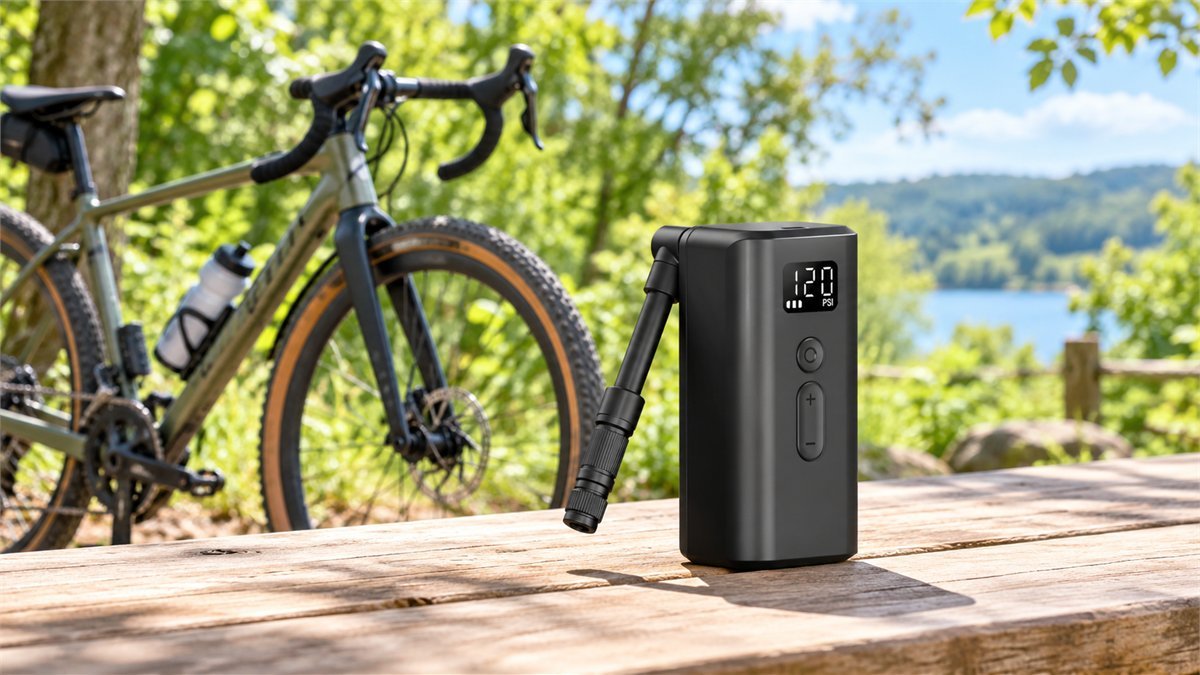
With A4, the hose is part of the package rather than another small accessory to find in a repair pouch. It rotates through 180 degrees, letting you choose a more convenient angle between the pump and valve. That should be useful when the valve sits close to a spoke or when you want the display facing you instead of the wheel.
The practical gain is flexibility. You are not trying to hold the whole pump rigidly against the valve throughout inflation, and the connection is easier to arrange before starting. Support the pump in your hand rather than leaving its weight hanging from the valve; a flexible connection is a convenience, not a reason to pull on a delicate valve stem.
At 102 × 50 × 45 mm, A4 is a compact bag-sized tool. It makes particular sense in a frame bag, commuter pouch or shared repair kit where an extra 90 g is less important than having the hose and a larger battery together. A minimalist road rider who wants the smallest possible jersey-pocket load has a stronger reason to consider AS2 Pro.

How much inflation does the A4 battery buy you?
CYCPLUS lists A4’s battery as 2,000 mAh at 7.4 V, or 14.8 Wh. The voltage matters: milliamp-hours alone are not enough to compare two batteries. AS2 Pro’s manual lists 420 mAh at the same 7.4 V, which works out to approximately 3.1 Wh. A4 therefore has about 4.8 times the nominal battery energy, although that does not mean 4.8 times as many tire fills in every situation.
The manufacturer’s A4 performance chart is more useful than a single “up to” claim because it identifies the tire and starting pressure. These are CYCPLUS’s published results, not measurements from our own test:
| Tire size | Pressure range | Approximate time | Fills per charge |
|---|---|---|---|
| 700 × 25C | 0 to 80 PSI | 60 seconds | 19 |
| 700 × 25C | 0 to 120 PSI | 120 seconds | 9 |
| 700 × 28C | 0 to 80 PSI | 70 seconds | 15 |
| 29 × 2.2 inches | 0 to 30 PSI | 80 seconds | 15 |
These figures describe the manufacturer’s specified tire tests. They are not a promise of the same results with every tire, temperature, battery age or sequence of back-to-back inflations.
The contrast between 19 fills at 80 PSI and nine at 120 PSI is the important part. Higher pressure makes the job substantially more demanding, even with the same tire. A wider tire changes the amount of air required as well. For a rider checking two bikes before a weekend outing, that larger battery suggests useful reserve; for a trip far from charging, it is still sensible to leave margin rather than plan around the last advertised fill.
Do not read 120 PSI as a recommended riding pressure. Choose pressure for your tire, rim, load and riding conditions, and stay within the lower applicable tire or rim limit. The pump’s maximum is a capability, not a target.
The pressure display is useful, but check it against your normal gauge
CYCPLUS advertises pressure accuracy within ±1 PSI for A4. That is a manufacturer claim rather than an independently confirmed accuracy result. The display is still a useful way to make inflation repeatable: use the same target, check the result and adjust your routine to suit your bike.
For the first few uses, compare the reading with a separate gauge you trust, with the pump stopped. This matters most when small pressure changes affect comfort or grip. An occasional comparison is more informative than assuming two different gauges must agree perfectly or deciding a tire is correctly inflated just because it feels firm.
CYCPLUS A4 vs AS2 Pro: bag space or pocket space?
These pumps solve a similar problem but favor different priorities. A4 spends its extra size on battery capacity and a permanently attached hose. AS2 Pro is easier to justify when every object in a jersey pocket has to earn its space.
| What matters | A4 Mini Air Pump | AS2 Pro |
|---|---|---|
| Listed pump weight | 210 g | 120 g |
| Listed dimensions | 102 × 50 × 45 mm | 70 × 49 × 28 mm, per the current manual |
| Battery | 2,000 mAh at 7.4 V; 14.8 Wh | 420 mAh at 7.4 V; about 3.1 Wh calculated |
| Maximum pressure | 120 PSI | 120 PSI |
| Claimed pressure accuracy | ±1 PSI | ±1 PSI |
| Hose arrangement | Integrated, 180-degree rotation | Direct connection or included extension hose |
| Presta / Schrader | Included converter for Presta; direct Schrader connection | Configurable nozzle and included accessories; follow the manual for each arrangement |
| Charging | USB-C; no verified full-charge time in the materials reviewed | USB-C; 30-minute full charge advertised |
| Best-fit rider | Commuter, shared-ride or bag-carrying cyclist prioritizing reserve | Rider prioritizing low weight and a smaller pocket load |
Specifications are manufacturer-listed. AS2 Pro’s accessories add to its bare-pump weight. The battery-energy comparison is a calculation, not a measured runtime comparison.
The independent AS2 Pro test by BIKE magazine adds some real-world context. With a 700 × 30 mm tire, it recorded 59 seconds to 4 bar and 161 seconds to 7 bar. It also measured 35°C and 62°C respectively at those pressures. These are results for AS2 Pro on a different tire, so they cannot establish that A4 is faster. They do show why high-pressure inflation calls for sensible handling and why the protective sleeve and hose are useful parts of the smaller pump’s kit.
For AS2 Pro, the manual specifically recommends its extension hose above 100 PSI to avoid connection leakage, and with TPU tubes that have resin valves to protect them from heat. Follow those instructions rather than treating the hose as optional in every situation. A4’s different hose design should not be assumed to have identical thermal behavior.

Presta, Schrader and the first five minutes with A4
A4’s supplied Presta converter is small, but it is important enough to keep with the pump. A battery-powered tool is only helpful on a ride if its valve connection matches the bike beside you. Before putting it in your bag, try the complete setup at home.
- Identify your valve. A4 connects directly to Schrader valves. For Presta, remove the cap, loosen the small valve nut and use the supplied converter according to the quick-start illustration.
- Arrange the hose before starting. Turn the wheel to an accessible position and rotate the hose so the connection is straight and the screen is readable. Avoid pulling sideways on the stem.
- Set the intended pressure and check the units. The official A4 quick-start shows the plus and minus controls for the target and the round control for starting inflation. Use the instructions supplied with your unit for its exact button sequence.
- Watch the first inflation. Listen for a connection leak and confirm that pressure increases. Stay with the pump instead of relying on an assumption about its stop behavior.
- Check the tire and repack the adapter. Disconnect without forcing the valve, close a Presta valve nut and replace the cap. Store the converter where it will be easy to find after the next puncture.
If you run TPU inner tubes, check the tube maker’s electric-pump guidance before choosing your connection. AS2 Pro has explicit hose instructions for resin valves; the current A4 materials reviewed do not give the same detailed tube-specific guidance. Confirming compatibility is more useful than assuming every flexible hose offers the same protection.
For tubeless setups, think of A4 primarily as an inflation and top-up tool. A 120 PSI specification does not demonstrate the high initial airflow needed to seat every loose tubeless bead. If installing new tires is the main job, a floor pump with a suitable charge chamber or another bead-seating solution is a more relevant comparison.
Charging and carrying it without adding another chore
A4 uses USB-C, and its specification sheet lists 5 V/2 A as one supported charging input. Use a suitable charger and the supplied cable, following the unit’s instructions. The larger battery is an appealing reason to choose it, but a verified A4 full-charge duration was not available, so AS2 Pro’s advertised 30-minute recharge should not be transferred to this model.
The simple routine is to recharge after substantial use and check the battery before a longer ride. Keep the pump and connectors dry, let a warm pump cool before packing it tightly, and store it where the controls will not be pressed by other tools. For remote routes, a small manual backup remains useful because it does not depend on battery charge; A4’s extra reserve reduces one concern without replacing puncture-repair supplies.
If you travel with a shared USB charger, check that your cable ends match its ports before leaving. That small detail came up in an AS2 Pro owner’s travel account and is an easy annoyance to avoid with either model.
If the first inflation does not go as expected
These are connection checks, not a list of established A4 defects. A new pump is worth trying at home while a familiar gauge and another pump are within reach.
- Air hisses around the valve: stop, check the valve type and adapter, and reconnect without cross-threading or overtightening. If it still leaks with the correct fitting, ask support to check the seal or accessory rather than forcing it.
- The motor runs but tire pressure does not rise: stop and check that a Presta valve is open and the connection is correct. Inspect the tire or tube for an unresolved puncture. Repeatedly running the pump will not repair an air leak.
- The reading differs from your usual gauge: compare both with inflation stopped and use the tire/rim limits as the boundary. A persistent large discrepancy warrants a support check, not compensating by adding an arbitrary amount of pressure.
Who should choose the CYCPLUS A4?
A4 is the more compelling choice for a rider who carries a bag and wants a self-contained, higher-capacity pump. The rotating hose is useful every time you connect it, while the larger battery gives a concrete reason to accept the extra weight. That combination fits commuting, shared rides and travel where compactness matters, but shaving the last few grams does not.
Choose AS2 Pro when pocket size is the priority. It has a smaller battery, but its lighter body and more established owner experience make it a sensible comparison for solo riders who mainly want roadside help. A4’s promising published capacity is a reason to consider it, not a substitute for long-term ownership evidence.
Before deciding, compare the current prices and available offers on CYCPLUS Coupons & Deals. Keep the choice centered on where you will carry the pump, which valves you use and how many tires you expect to service between charges.
If you are putting together a complete ride kit, Cycling Coupons & Deals is also useful for comparing cycling accessories. Leave space and budget for the repair supplies that match your tires; a convenient pump works best as part of a kit you already know how to use.
Questions worth settling before you buy
Can the CYCPLUS A4 inflate car tires?
No. CYCPLUS’s A4 materials explicitly say not to use it for car tires. Its 120 PSI maximum does not establish suitability for the much larger air volume of a car tire.
Does A4 really inflate 19 tires on one charge?
CYCPLUS lists 19 fills for a 700 × 25C tire from 0 to 80 PSI. Its chart lists nine fills for that tire from 0 to 120 PSI and different results for other sizes. Treat those as manufacturer benchmarks, not a universal tire count.
Is the A4 compatible with Presta valves?
Yes, using the included Presta converter. Schrader valves use the direct connection. Check the correct arrangement at home and carry the converter with the pump.
Is A4 lighter than AS2 Pro?
No. The listed pump weights are 210 g for A4 and 120 g for AS2 Pro, before the smaller pump’s extra accessories. A4 trades additional weight and size for a larger battery and an integrated hose.
Sources
- CYCPLUS A4 specification sheet: dimensions, battery and charging inputs.
- CYCPLUS A4 inflation chart: tire sizes, pressure ranges, times and fills per charge.
- CYCPLUS A4 application guidance, including the car-tire exclusion.
- CYCPLUS AS2 Pro instruction manual: specifications, valve setup, hose use and heat precautions.
- BIKE magazine’s AS2 Pro hands-on test: inflation time and temperature measurements.
- CYCPLUS A4 and AS2 Pro product materials and six readable AS2 Pro customer reviews, checked November 1, 2026. Owner accounts are anecdotal and concern AS2 Pro, not A4.
DiscountedSavings may earn a commission from qualifying purchases through product links.