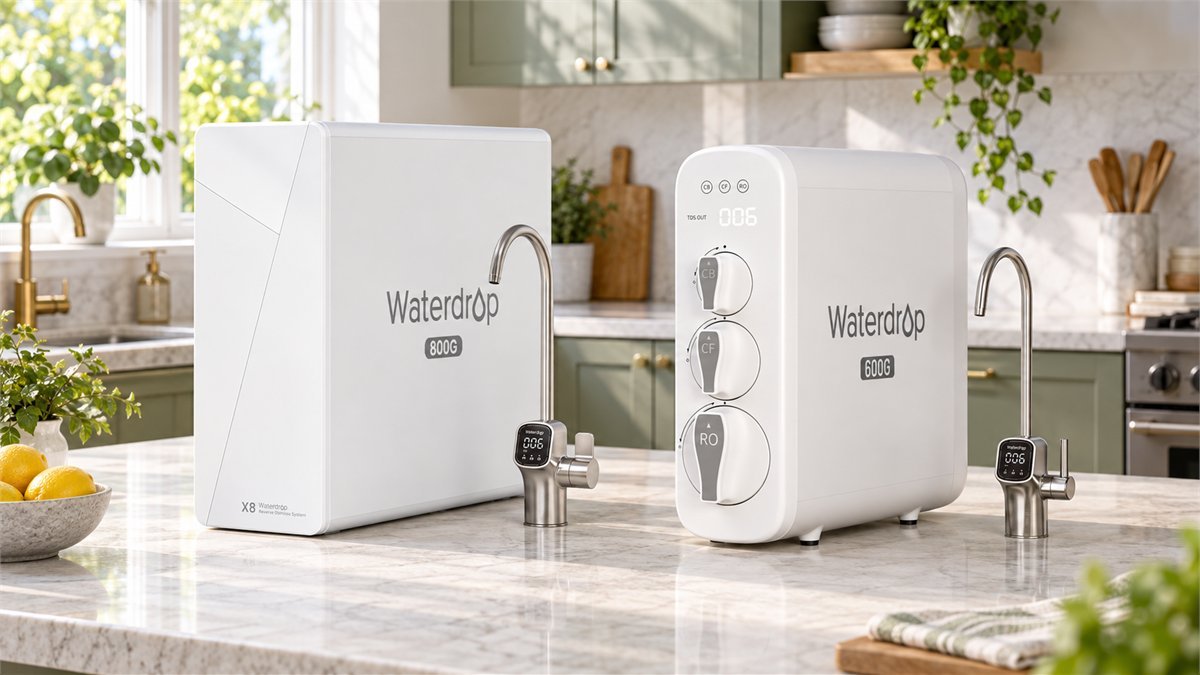
Waterdrop X8 vs G3P600: Is the X8 Worth Paying More For?
A drinking-water filter should make the kitchen easier to live with. Less hauling bottles. More room under the sink. A glass of water that tastes good without another jug taking over the refrigerator. Both the Waterdrop X8 and G3P600 promise that kind of convenience, which makes the more expensive X8 a surprisingly tricky purchase to justify.
The useful question is not whether 800 is a bigger number than 600. It is whether the X8’s extra output, different cabinet shape and longer stated warranty solve a problem you will actually notice. Replacement filters, installation and the way each system behaves between drinks matter just as much as the headline flow rating.
The short answer: the G3P600 is the stronger value starting point for everyday drinking and cooking. The X8 becomes more appealing when you regularly fill larger containers, need a slightly shorter unit, or value its two-year limited warranty. Neither its higher price nor its extra filtration-stage count establishes that it delivers safer water for your particular home.
Waterdrop X8 vs G3P600: the differences that matter
These are the standard X8 and G3P600 systems, not the X8-A, X8-PRO or G3P800. Similar names conceal different filters and features, so compare the model printed on the order rather than borrowing specifications from the rest of the range.
| Buying consideration | G3P600 | X8 |
|---|---|---|
| Rated production | 600 gallons per day | 800 gallons per day |
| Advertised purified-to-drain ratio | 2:1 | 2:1 |
| Housing, length × width × height | 18.12 × 5.67 × 17.72 in | 18.2 × 6.25 × 16.72 in |
| Faucet information | TDS reading and filter-life indicators | TDS reading and filter-life indicators |
| Replacement filter family | CF, CB, G3P600 RO | F2, F1G, X8-F3 |
| Standard remineralization / UV | Neither included in the base system | Neither included in the base system |
| Limited warranty stated in the manual | 1 year | 2 years |
| Installation essentials | Cold-water connection, suitable drain connection, electrical outlet and a dedicated RO faucet | |
Housing dimensions above follow the manufacturer manuals; they are not installation clearances. Product-page rounding varies slightly. Published specifications checked September 26, 2026.
800 GPD does not mean you need an enormous household
Gallons per day is a production rating, not a suggested drinking allowance. It helps distinguish membrane output under specified conditions. For a buyer standing at the sink, the attraction of a higher rating is usually a shorter wait while filling a bottle or saucepan.
On paper, 800 GPD is one-third more production than 600 GPD. For the same volume, that translates to a theoretical 25% reduction in filling time, not a 33% reduction. Actual faucet performance also depends on incoming water, temperature, pressure and filter condition, so this is a comparison of ratings, not a timed kitchen test.
The manuals use 77°F water and 30 psi dynamic inlet pressure for the production rating. A cold winter supply is not that test environment. Before paying extra for speed, think about your routine: a few glasses spread through the day leave less room for a noticeable benefit than several large bottles filled together each morning.
Why the G3P600 is the sensible starting point
The G3P600 gives you the main reasons people consider tankless RO in the first place: no separate storage tank, a tidy enclosure and front-access filter cartridges. Importantly, its faucet already displays TDS and filter status. You do not have to buy the X8 just to see those readings at the sink.
That makes the less expensive model an appealing fit for a household moving away from bottled water or replacing a bulky older RO installation. Money left over can cover the less glamorous parts of the project: a proper faucet opening, an electrical outlet or an installer who checks the connections before closing the cabinet.
There are compromises. It is taller than the X8, the pump will not disappear into complete silence, and buying into this system also means buying its replacement-cartridge family. Still, when both models fit and the faster flow is a nice-to-have, the G3P600 does not lose its basic usefulness merely because a newer-looking machine exists.

Where the X8 earns its extra cost
The X8 has a more convincing case when you can name the improvement you want. Higher rated production is one. Its housing is about an inch shorter but a little wider, which can be an advantage beneath a deep sink and a disadvantage beside a crowded disposal. Neither machine wins every cabinet.
The other tangible difference is the manual’s two-year limited warranty versus one year for the G3P600. Extra coverage is worth considering for a powered appliance that sits out of sight, but it is not a promise of twice the service life. Installation, water conditions, exclusions and the practical process for getting a replacement still matter.
The X8 has an idle-water refresh cycle
The X8 manual describes automatic fresh-water production after ten minutes without filtering. That is a genuine difference in everyday behavior: the machine may do work between visits to the tap. It also means the advertised 2:1 ratio is not a complete prediction of household water use.
Both systems send water to the drain and perform maintenance flushing. At a nominal 2:1 purified-to-drain ratio, producing two gallons of drinking water corresponds to one gallon of drain water during that rated process. Start-up and maintenance cycles are additional considerations. The X8’s higher output rating does not establish lower water bills than the G3P600.
For frequent larger fills, the X8’s combination of throughput, shape and warranty may be worth paying for. For occasional glasses, it is a comfort upgrade rather than an obvious necessity.

Replacement filters: the cost you will keep paying
A sale price lasts one checkout. The cartridge schedule stays with the machine. Both systems have a six-month prefilter, a twelve-month carbon filter and a membrane rated for up to twenty-four months. Those are upper time limits, not guaranteed service lives.
| Filter role | G3P600 | X8 | Maximum time interval |
|---|---|---|---|
| Pre-sediment / carbon block | CF: $29.99 | F2: $30.99 | 6 months |
| Activated carbon | CB: $29.99 | F1G: $29.99 | 12 months |
| RO membrane | G3P600 RO: $109.99 | X8-F3: $139.99 | 24 months |
Using those individual prices, the steady-state annual filter allowance is approximately $144.97 for G3P600 and $161.97 for X8. That is about $17 more per year for the X8, before subscriptions, bundles or other offers. The difference is real, but it is not large enough to make the purchase-price gap irrelevant.
The first five years need a slightly different calculation because a new system already includes filters. Under the full calendar schedule, replacements before the fifth anniversary are nine six-month filters, four annual filters and two membranes. That gives $609.85 for G3P600 and $678.85 for X8 in replacement purchases. Filters due exactly at month 60 start the next period and are not included.
Five-year purchase and filter estimate
USD. The starting purchase prices below are reference prices, not a checkout quote. This estimate assumes the supplied filters and the full calendar replacement schedule; installation, water, electricity, tax, shipping, repairs and optional accessories are excluded.
Replacement-filter prices
X8 costs $329.00 more in this example.
Enter a valid, non-negative price in every field.
The figures shown use the reference prices above. Interactive recalculation requires JavaScript.
High use can shorten that schedule
The G3P600 manual also specifies capacity limits: 550 gallons for CF, 1,100 for CB and 2,200 for RO, with replacement when time or capacity runs out first. For perspective, four gallons of filtered water a day would reach 550 gallons in about 138 days, before six months. Cooking water and multiple reusable bottles can add up.
The X8 also bases its reminders on time or processed volume. Water quality can shorten service life on either system. Treat the calculation as a transparent budgeting scenario, not a promise that every household will buy exactly the same number of filters.
What owners like, and what deserves a second look
For G3P600 owners, the recurring appeal is ordinary convenience: good-tasting water on demand, less clutter than an older tank system and accessible cartridges. Some find installation straightforward. Others discover that the filter is the easy part and the countertop hole or missing outlet is the expensive part.
Noise is more divisive. Owners describe everything from unobtrusive operation to a pump that is noticeable in a quiet kitchen, particularly when the cabinet amplifies vibration. That does not support calling every unit loud, but it does make a bedroom-adjacent kitchenette a different buying decision from a busy family kitchen.
There are also G3P600 reports of leaks, water collecting in the rear tray and frustrating support exchanges. Other buyers describe prompt replacements. These reports deserve attention without becoming an invented failure rate. In a separate discussion, one G3P600 owner reported at least three years without a leak. That counterexample matters too.
The X8’s smaller set of model-specific reviews is positive about taste, appearance and compactness. It also includes a buyer who needed a plumber and another whose favorable impression covered only a few weeks. That is encouraging early-use feedback, not enough long-term evidence to declare the X8 the reliability winner.
The useful response is to make serviceability part of the purchase. Keep access to the shutoff and rear connections, check for moisture during commissioning and after filter changes, and consider a separate leak alarm. If water is escaping, stop using the system, shut off its water supply and arrange proper diagnosis rather than repeatedly emptying a tray and carrying on.
Measure the awkward spaces before ordering
A narrow enclosure can still be difficult to live with if its filters face a cabinet wall. Measure the usable space around the disposal, drain trap and hinges, not just the empty cabinet opening. Leave room for tubing to curve without kinking and for cartridges to slide out. A unit that only fits when jammed against the cabinet is not a comfortable fit.
Both models need electrical power. If the only outlet is controlled by the garbage-disposal switch, plan a suitable continuously powered connection with an electrician. For a stone countertop without a spare opening, get a faucet-hole quote before choosing between the two machines. A small difference in appliance price can disappear inside that installation bill.
Incoming water matters as well. Both manuals specify 14.5-87 psi and 41-100°F feed water. The X8 warranty conditions also specify TDS below 750 ppm, hardness below 7 grains per gallon and pH between 6.5 and 8.5. Hardness and TDS are not interchangeable measurements. If your water falls outside the stated conditions, resolve pretreatment and warranty suitability before buying.
A refrigerator connection is a separate compatibility question
If the plan is to supply an ice maker as well as the drinking faucet, do not assume a tee fitting settles everything. The refrigerator’s pressure requirement and the RO system’s start-stop behavior need to work together. G3P600 owners have reported needing an additional small tank for their installations. Confirm the exact refrigerator and accessory arrangement in writing, and include it in the installed cost.
Better-looking numbers do not automatically mean better water
The faucet display is useful, but TDS means total dissolved solids. It does not identify individual contaminants or provide a pass/fail safety test. A very low number alone cannot tell you whether the system addresses a particular substance in your water.
Certification needs the same careful reading. NSF’s explanation of Standard 58 separates the required TDS-reduction test from additional, specific reduction claims. Standard 372 concerns lead content in components, not proof that a system removes lead from incoming water. Look for the exact model and the specific certified claim that matches your water report.
That is why an extra filtration stage should not decide this comparison on its own. For a known contamination issue, ask for the current performance data sheet and certification listing rather than relying on a broad list of substances in an advertisement. Water from a private well needs source-water assessment; neither machine should be treated as a universal solution for an untested supply.
And what about taste, coffee and remineralization?
Neither standard model includes the alkaline or remineralization feature found in some neighboring versions and bundles. RO changes mineral content, so the result may taste pleasantly neutral to one person and too flat to another. Owner feedback reflects both reactions.
For coffee, the important question is the water that reaches your brewer, not the number of filtration stages. Check the brewer’s water recommendations and any compatible remineralization accessory before adding it. Treat remineralization as a separate taste and equipment-compatibility decision, with its own cartridge cost, rather than an automatic reason to buy the more expensive base system.
Living with either system after installation day
Filter changes involve more than swapping a cartridge and walking away. The manuals specify resetting the correct filter indicator and completing the appropriate flush. The carbon-filter flush is fifteen minutes, while an RO-membrane replacement calls for thirty; the prefilter has a different automatic cycle. Follow the instructions for the cartridge you changed, not a generic video for another Waterdrop model.
Brief automatic flushing can be normal. Continuous unexplained drain flow, a leak warning or repeated abnormal noise is a different situation and deserves investigation. Likewise, one TDS reading immediately after the system has sat idle should not become a verdict on the membrane. Look at the manual’s troubleshooting guidance and a repeatable pattern rather than chasing a single number.
Finally, keep the model number, purchase receipt and filter replacement dates together. When a part needs attention, being able to identify the system and describe when the symptom occurs is more useful than remembering that it was the white Waterdrop with the digital tap.
Which one would make more sense in your kitchen?
Start with the G3P600 when both models fit, your main goal is convenient drinking and cooking water, and the X8 carries a meaningful price premium. Its lower filter budget reinforces the value argument instead of reversing it later.
Choose the X8 when larger fills are a frequent part of the day, its shorter enclosure solves a real clearance problem, or the longer limited warranty matters enough to justify the difference. The closer the actual purchase prices, the easier that upgrade becomes to defend.
Pause on both if the water conditions, electrical connection, refrigerator compatibility or contaminant-specific requirements remain unresolved. Those are purchase conditions, not small details to sort out after the box arrives.
Once you know which model fits the job, check Waterdrop coupons and deals for available offers. Compare the final price of the exact model and bundle; a lower price is only useful when it buys the system you actually need.
Questions buyers often ask
Is the X8 worth replacing a working G3P600?
Usually not for the larger GPD number alone. A replacement makes more sense if the G3P600’s flow or physical dimensions are causing a recurring problem. Otherwise, maintaining a system that already suits your kitchen avoids another appliance purchase and installation.
Does the X8 use less water than G3P600?
Both advertise a 2:1 purified-to-drain ratio. That is not evidence of an X8 water-saving advantage over G3P600. Household results also depend on flushing, usage patterns and water conditions.
Are their replacement filters interchangeable?
They use different cartridge families. Match G3P600 replacements to CF, CB and the G3P600 membrane; match the standard X8 to F2, F1G and X8-F3. Check any proposed alternative against the exact model rather than assuming all Waterdrop cartridges fit.
Will either work during a power outage?
Both rely on a powered pump and neither standard installation has a separate drinking-water storage tank. Do not count on normal dispensing during an outage; keep drinking water available separately.
Further reading: X8 installation and maintenance manual; G3P600 installation and maintenance manual; G3P600 owner feedback; X8 owner feedback.
DiscountedSavings may earn a commission from qualifying purchases through product links.