Imarku Knife Review: Sharpness, Comfort and Which Blade to Choose
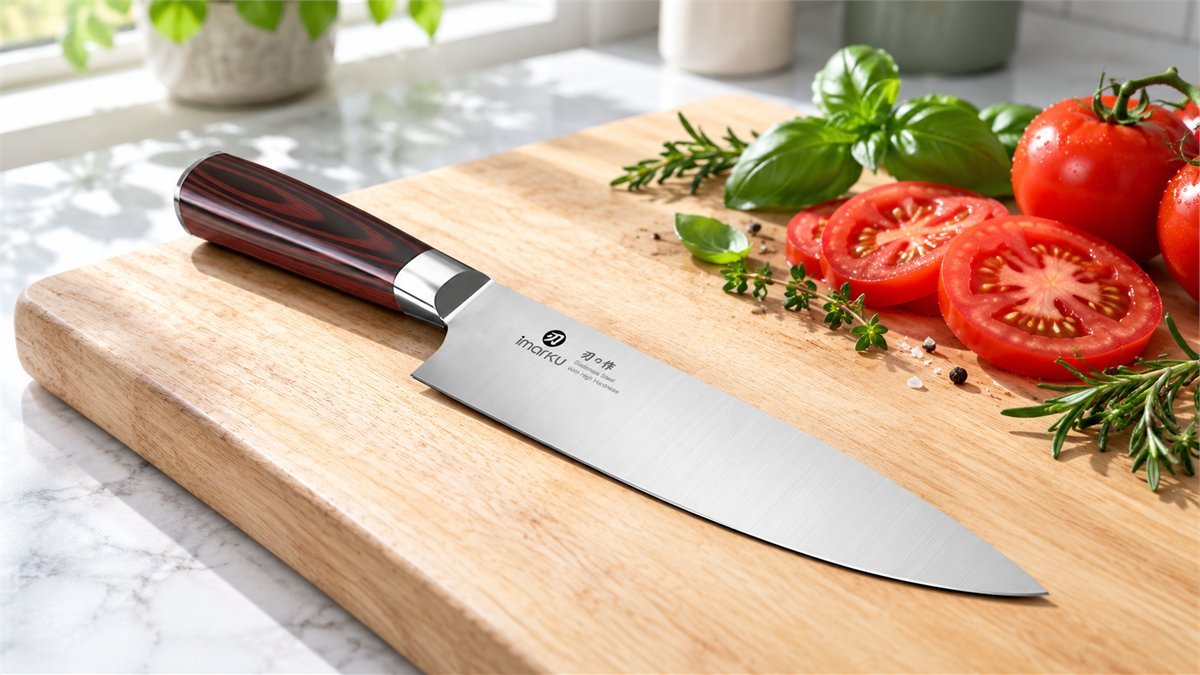
A comfortable kitchen knife makes the small jobs of cooking more satisfying: slicing a tomato for lunch, chopping herbs for a sauce, or working through an onion without interrupting your rhythm. That everyday usefulness is the strongest reason to look at imarku. Rather than starting with a large knife block, you can choose a single blade around the food you enjoy preparing.
This imarku knife review compares the Phantom P8 chef knife, hammered Pinnacle P8S and all-steel Gintama G03 santoku using their published specifications and available owner and independent reviews. Each offers a different combination of reach, blade height and handle shape.
The short answer: the P8 is the most straightforward starting point for varied home cooking. Choose the shorter G03 if you prefer controlled push cuts through vegetables, or consider the taller P8S when extra knuckle clearance matters. The best value is the shape you will reach for every day, paired with ordinary washing, storage and edge care.
Why Buyers Like Using These Knives
In the customer comments displayed with the P8, initial sharpness, comfortable handling and value are recurring positives. For a home cook replacing a worn everyday knife, those are useful qualities: a clean start to the cut, a handle that feels natural, and one tool that covers much of the preparation for dinner.
A Comfortable Grip for Everyday Preparation
One P8 reviewer favored the fit for smaller hands; another, who described wearing large gloves, also liked it. Their experiences suggest it is worth trying rather than choosing by hand size alone. The practical check is simple: hold the knife in your usual cooking grip and see whether your hand can stay relaxed with enough clearance above the board.
A contributor to a specialist knife discussion also described liking the handles after a year of using unspecified imarku knives in a commercial kitchen. That is a longer-term individual account rather than a test of all three models here, but it highlights why handle comfort deserves attention alongside blade specifications.
Useful Sharpness, Not Just an Impressive First Slice
A 2025 Vegan Anj review found a brand-supplied 8-inch chef knife effective for everyday plant-based preparation. That is a helpful use case for cooks who spend most of their board time on vegetables and herbs. The P8’s owner comments point in a similar direction on initial sharpness, although neither source establishes how long every edge will last.
Shape helps explain the rest of the experience. A curved chef knife lends itself to rocking through herbs; a shorter santoku suits controlled push cuts. Choosing the motion you already enjoy is a more useful starting point than choosing the highest hardness number.
P8 vs P8S vs G03: The Differences That Matter
| Detail | Phantom P8 | Pinnacle P8S | Gintama G03 |
|---|---|---|---|
| Knife style | 8-inch chef / gyuto-style | 8-inch hammered chef | 7-inch hollow-edge santoku |
| Published blade material | 7Cr17MoV stainless steel | High-carbon stainless steel; no alloy grade specified in the current specification panel | High-carbon stainless steel; no alloy grade specified in the current specification panel |
| Claimed hardness | 56–58 HRC | 62 HRC; feature copy gives 62 ± 1 | Not stated in the current specification panel |
| Handle | Pakkawood on the brown version | Pakkawood | Stainless steel |
| Published overall length | 13 inches | 13 inches | 12 inches |
| Useful reason to consider it | A versatile first main knife | A taller blade and a different edge specification | Shorter reach and a flatter cutting profile |
Specifications above are manufacturer-stated, not independent measurements. The current P8S listing gives a 15-degree-per-side edge in its specification panel but a wider angle range elsewhere. Confirm the sharpening recommendation for your particular knife rather than treating a marketing range as a sharpening setting.
The P8: A Sensible Place to Start
The P8 has the familiar proportions of an everyday chef knife: enough length to work across a board, a pointed tip for more precise cuts, and a curved section for rocking. It is the most straightforward choice here for someone who does a little of everything rather than a large volume of one ingredient.
Picture a weeknight meal involving an onion, fresh herbs, a pepper and boneless chicken. One comfortable chef knife can handle the board work without constant swapping. It will not replace a bread knife for a crusty loaf or a small paring knife for delicate handheld work, but those are complementary tools rather than reasons to buy a huge set immediately.
The important question is whether the blade fits your board and your grip. A generous blade length is useful until the cutting area feels cramped. Leave space around the board, keep the surface stable, and make sure your knuckles have comfortable clearance when the cutting edge reaches it.

The P8S: Extra Blade Height and a Hammered Finish
The P8S offers a noticeably different set of proportions. Its published blade height is 2.3 inches versus 1.7 inches for the P8, making it worth considering when knuckle clearance is a priority. The taller profile will appeal more to someone who likes a substantial chef knife than to a cook working mainly with small ingredients on a compact board.
Higher HRC is not a complete performance score. Hardness, heat treatment, steel composition and geometry work together. A harder edge may resist deformation better, but that does not tell you exactly how long this finished knife will stay sharp or how it will tolerate a sideways load. A verified head-to-head cutting test would be needed to establish those differences.
The hammered finish gives the P8S its distinctive appearance. The manufacturer also describes it as helping food release, though that depends on the ingredient, moisture and blade geometry. Treat the taller shape and finish as the clear reasons to shortlist it; food-release performance is something to assess with your usual ingredients.
Choose the P8S when those proportions suit your grip and board. For someone who simply wants a versatile first chef knife, the P8 remains the more direct comparison. Include a suitable cutting board and edge maintenance in the budget whichever model you choose.

The G03 Santoku: A Different Kind of Everyday Knife
The G03 takes another route. It combines a 7-inch santoku blade with a stainless-steel handle and shallow hollows along the blade. It is not the wood-handled imarku santoku that appears in many older reviews, so praise for that handle should not be transferred to this one.
A santoku is worth considering when your normal preparation is a board of vegetables, herbs and smaller boneless portions. Its comparatively flat profile suits controlled push cuts. If you habitually rock a chef knife through everything, allow for the different motion rather than expecting the same feel with an inch removed.
The metal handle offers a different surface and shape from pakkawood, so grip preference can help settle the choice. With dry hands and a dry handle, look for a relaxed, controlled hold. Combined with the shorter blade, that is the G03’s practical appeal for someone who prefers a compact everyday knife.
The G03 and an 8-inch chef knife cover many of the same tasks. Start with your preferred shape; adding the other later makes sense if you discover a distinct job you enjoy using it for.

What to Check During Your First Week
A few P8 owners reported a disappointing edge or rough finishing at the handle join; one reported a split handle and a replacement. These isolated accounts make a brief arrival check useful, rather than establishing a fault shared by every knife. Check the grip and construction before settling into your regular cooking routine.
Do the checks below before the knife disappears into your normal kitchen routine. First read the seller’s return conditions: using or sharpening a knife can affect whether it qualifies for a change-of-mind return. Keep the packaging and purchase details until you know you are satisfied.
Once you decide to use it, wash and dry it according to the care instructions. A ripe tomato and a small onion can reveal more about your everyday needs than an elaborate demonstration. Work slowly on a stable board, with fingers safely clear of the edge. Notice whether the knife begins the cut cleanly, whether it passes through without excessive force, and whether the handle remains comfortable.
Judge both the start and the rest of a cut. A historical Chefs Resources test from 2016 found its sample sharp but resistant in dense produce; it was not a test of today’s P8. Metallurgist Larrin Thomas explains the useful distinction: edge sharpness and the geometry behind the edge both affect cutting. Your normal ingredients are a better guide to suitability than a paper-slicing demonstration.
Keep the check to normal food preparation. Never test against your skin, flex the blade or force a difficult cut; stop and assess the cause if excessive pressure is needed.
Common Questions After Purchase: What to Try, and When to Stop
| What you notice | A useful next step | When to contact the seller or a sharpener |
|---|---|---|
| New knife struggles to start a cut | Check for visible damage and confirm it is the model ordered. Do not assume a new edge must be rebuilt at home. | Before sharpening or modifying a newly delivered knife that seems defective. |
| Used knife needs increasing pressure | Review the cutting surface and arrange suitable edge maintenance. Do not compensate by gripping harder. | If performance remains poor after appropriate sharpening, or the edge is visibly chipped. |
| Sharp at the surface, resistant deeper into food | Consider blade geometry, ingredient size and technique, not just edge sharpness. Stop if a cut needs force. | Before attempting blade thinning or changing the edge geometry yourself. |
| Rough joint, split handle or movement | Stop using it if grip or structural integrity is affected; photograph the problem. | Promptly. Glue, sanding or continued use is not the first response to a new defect. |
| Spots or discoloration | Wash gently with mild detergent, rinse and dry. Review soaking, dishwasher exposure and food residue. | If there is pitting, a damaged edge or persistent corrosion. Ask which cleaner is safe for that finish. |
There are individual reports of successful replacements, including the P8 handle complaint and knife-set buyers on Trustpilot. That is encouraging, but it is not a promise that every claim will be handled the same way. Keep a clear photograph, order number and a short description of normal use. Report the actual symptom rather than trying an irreversible repair first.
A Simple Routine for Keeping the Knife in Good Shape
Wash, Dry, Then Put It Away
Imarku’s knife-care guidance recommends hand washing and prompt drying. For the knives considered here, that is the sensible default even when a different all-steel set elsewhere is advertised as dishwasher safe. Avoid soaking the handle and do not leave the blade buried in a sink.
Make cleanup a small part of cooking, not a project left until bedtime: rinse away food residue, wash carefully with mild detergent, dry both blade and handle, and store the knife securely. Do not rub a cloth along the cutting edge. Clear separation from other utensils protects both your fingers and the edge.
A wooden or suitable plastic cutting board is a practical companion. Glass, stone and a bare countertop are poor substitutes for a cutting board. Use a bench scraper to move chopped ingredients rather than repeatedly dragging the knife’s edge sideways across the surface.
Honing and Sharpening Are Not Interchangeable
A maintenance rod can help with some edge conditions, but it cannot be assumed to repair chips or restore every worn bevel. Different rods also behave differently: abrasive ceramic and diamond tools remove material, so they are not harmless accessories to use without regard to angle or pressure.
Start with the recommendation for your exact model. The P8 specification lists a 12.5-degree edge angle; the P8S panel lists 15 degrees per side. Do not automatically apply one setting to both, and ask imarku for clarification if the instructions supplied with your knife differ from the listing.
If you are new to sharpening, a competent kitchen-knife sharpener is often a more predictable starting point than aggressive work with an unfamiliar pull-through tool. Ask for an edge suited to ordinary food preparation and explain whether you have noticed slipping, chipping or resistance in dense vegetables. Sharpening should solve a specific problem, not chase the smallest possible angle.
Keep a Different Tool for Rough Jobs
These are food-preparation knives, not tools for prying packaging open or chopping through frozen food and bones. A hard blade is not automatically a tough blade, and a thin edge can suffer from twisting. Use the appropriate separate tool for the task. That small habit is more useful than trying to prove how strong a new knife is.
Is an Imarku Knife Worth Buying?
Imarku is worth shortlisting for a practical everyday knife, especially when you want to choose one useful blade rather than a full set. The P8 is the natural starting point for varied home cooking, the G03 suits a preference for shorter push cuts, and the P8S earns its place when its taller profile is what you want.
For a small kitchen, one well-chosen main knife, safe storage and a way to maintain the edge make a coherent setup. A bread or paring knife can complement it as your cooking requires. If comparing sets, check the actual cutting tools included: the headline piece count may also cover scissors, steak knives, a sharpener and the block.
Once you have chosen a shape, check Imarku Coupons & Deals for available offers and tracked prices. Compare the same knife and handle variant, include shipping and confirm the coupon conditions to find the most useful offer for your choice.
A suitable board and secure storage complete the setup. Browse Kitchen & Dining Coupons & Deals to compare those practical additions alongside other preparation tools.
Questions Before Choosing an Imarku Knife
Are imarku knives made in Japan?
Do not read “Japanese chef knife” as a verified manufacturing origin. It can describe a style, while references to Japanese or German steel describe a material claim. Older reviews and customer accounts identify Chinese-made products. If manufacturing origin matters to you, ask for the country of manufacture of the exact SKU and check its packaging; do not assume one answer covers every series.
Is the P8S better than the standard P8?
It has different published specifications, including a taller blade and higher claimed hardness. That is not enough to prove longer edge life or a better fit for your hand. Consider its dimensions and maintenance requirements alongside the price difference.
Will an imarku knife rust?
Stainless steel is corrosion-resistant, not permission to leave a knife wet indefinitely. Follow the care instructions, avoid soaking, and dry it promptly. Persistent spots, pitting or damage deserve advice from the seller rather than increasingly abrasive home treatments.
Should I buy the chef knife or the santoku?
Choose the 8-inch chef knife for a versatile main blade with more reach and a curved cutting section. Consider the 7-inch G03 santoku if you prefer a shorter blade and controlled push cuts. Board space, grip and your usual ingredients matter more than the name.
How often will it need sharpening?
There is no reliable calendar interval for every cook. Frequency depends on use, cutting surface, storage and the edge’s condition. Arrange maintenance when controlled cutting deteriorates; do not wait until extra force feels normal. A new knife with a poor edge should be raised with the seller first.
Sources
- Imarku’s current Phantom P8, Pinnacle P8S and Gintama G03 specifications, plus customer comments displayed with the P8.
- Imarku knife-care guidance: cleaning, drying and storage
- Imarku use-and-care instructions: cutting surfaces and unsuitable tasks
- Vegan Anj: 2025 chef-knife review using a brand-provided sample
- Chefs Resources: historical 2016 test of an 8-inch imarku chef knife
- r/TrueChefKnives: budget santoku discussion with an individual imarku ownership report
- Trustpilot: knife-set handle-finish and replacement account
- Trustpilot: knife-set handle-damage and support account
- Knife Steel Nerds: why initial sharpness and complete cutting performance differ
- Knife Steel Nerds: hardness, heat treatment, geometry and sharpening tradeoffs
DiscountedSavings may earn a commission from qualifying purchases through product links.