GOOLOO A9 Ultra vs A3 Pro: 6000A vs 3000A, Tire Inflation, USB-C Power, and Which One to Buy
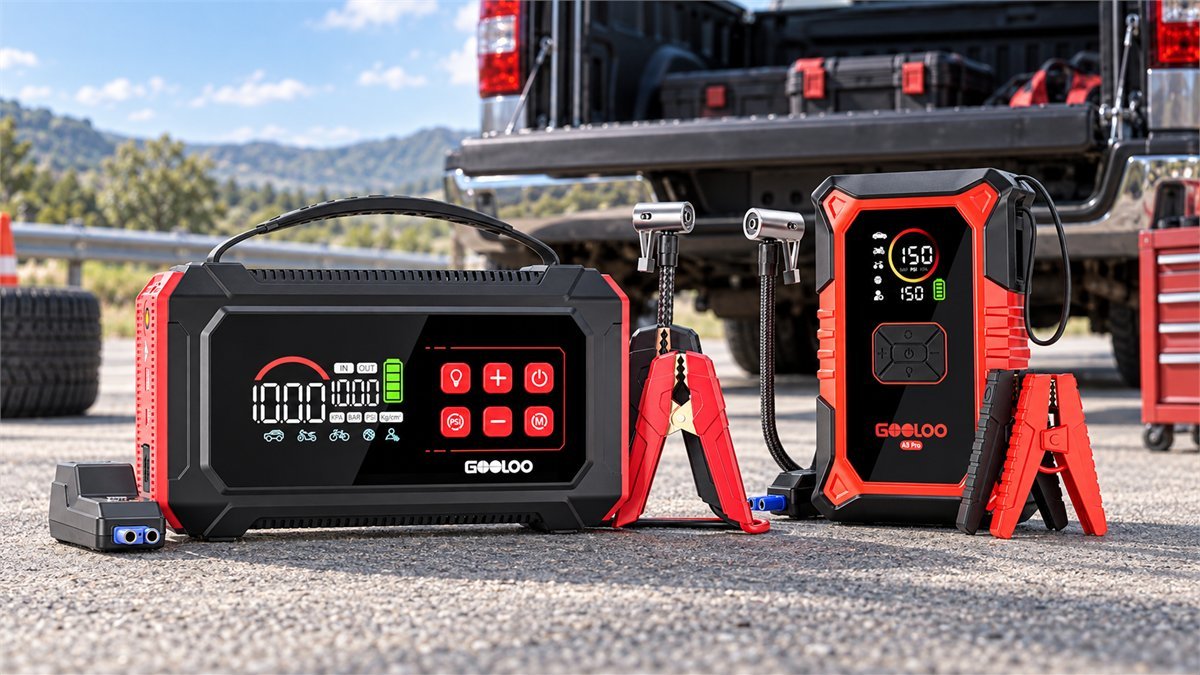
GOOLOO has just introduced the A9 Ultra, a broad-shouldered roadside power kit built for trucks, RVs, off-road travel, and drivers who want much more than a single emergency start. Beside it sits the smaller A3 Pro, an established 3000A jump starter that already covers the two problems most people actually meet: a tired 12V battery and a soft tire. The new model naturally wins the specification contest. The more interesting question is whether its larger battery, faster USB-C charging, and high-pressure compressor will change your life on the road enough to justify the extra size and cost.
Short verdict: choose the A3 Pro for an ordinary car, crossover, or light truck when compact size, proven everyday usefulness, and price matter most. Choose the A9 Ultra when the same device must support larger diesel vehicles, trailer or RV tires, repeated inflation work, laptops and cameras, or longer trips away from mains power. The A9 Ultra is the more capable machine; the A3 Pro is the easier value decision.
GOOLOO A9 Ultra vs A3 Pro specifications
| Feature | GOOLOO A9 Ultra | GOOLOO A3 Pro | Why it matters |
|---|---|---|---|
| Peak starting current | 6000A claimed | 3000A claimed | Peak current is a short marketing figure, not the whole starting story. Vehicle size, temperature, battery condition, cable contact, and sustained output matter too. |
| Published cranking output | 480A | 400A sustained for 5 seconds | The smaller gap here is more informative than the 6000A-versus-3000A headline. |
| Engine guidance | All 12V gasoline; up to 12.0L diesel in launch copy | Up to 9.0L gasoline / 6.5L diesel | The A9 page contains conflicting diesel guidance in its FAQ, so owners of very large diesels should confirm compatibility before relying on it. |
| Battery capacity | 27,000mAh / 99.9Wh | 44.4Wh | A9 carries about 2.25 times the energy, which is useful for electronics, repeated tire work, and reserve after a jump. |
| USB-C | Up to 100W bidirectional | Up to 30W PD | A9 can sensibly charge many USB-C laptops and can recharge much faster with suitable 100W equipment. |
| USB-A | 5V / 2.4A | Up to 18W QC | A3 may be quicker for some older USB-A devices; A9’s main advantage is its USB-C port. |
| Inflator range | Up to 160 PSI | 7-150 PSI | Both cover passenger tires. A9 is designed to remain useful at higher truck and trailer pressures. |
| Published inflation example | Car tire from 0 to 36 PSI in 5 minutes | No directly comparable Pro-model time published | Full inflation is demanding; routine top-offs should be quicker, but tire volume and ambient temperature change the result. |
| Display | Oversized LED display, claimed +/-1 PSI accuracy | 2.8-inch IPS color display, 0.1 PSI readout | Resolution is not the same as measured accuracy. Check both against a trusted gauge. |
| Emergency light | 400 lumens with SOS mode | LED light with strobe and SOS modes | A9 publishes an actual lumen figure; either is most valuable when the tool is positioned safely before work begins. |
| Recharge guidance | About 1.5 hours with suitable 100W charging | USB-C charging; recharge at least every 3 months | A fast refill is valuable only if the required wall charger and cable are available. A wall charger may not be included. |
| Product maturity | Newly launched | Established owner history | A3 has real-world reports; A9’s long-term cell retention, compressor wear, and enclosure durability still need time. |
The first surprise: 6000A is not twice the real starting power
The front of the box gives the A9 Ultra an effortless victory: 6000A sounds like twice the A3 Pro’s 3000A. Under the larger print, however, the comparison becomes more human. GOOLOO lists 480A of cranking output for the A9 Ultra and 400A sustained for five seconds for the A3 Pro. Those figures are not described under identical test language, so they still should not be treated as laboratory twins, but they show why peak amperage alone is a poor buying guide.
A jump pack does not start an engine in isolation. It works beside the vehicle battery, through a pair of clamps, over cables and terminals that may be cold, dirty, corroded, loose, or badly positioned. A healthy connection on a moderately discharged car can make a smaller pack look heroic. A frozen battery with an internal failure can defeat a far larger one. The A9’s value is therefore less about winning a dramatic amp-number contest and more about giving a larger engine, colder morning, or repeated roadside call a wider margin.
What the A9 Ultra adds beyond jump starting
The A9 Ultra looks less like a pocket battery and more like a compact roadside console. Its handle, broad display, compressor hardware, and 99.9Wh battery make sense when the tool is expected to stay beside a truck, trailer, RV, boat, or off-road vehicle. GOOLOO says it can deliver more than 40 starts per charge, inflate to 160 PSI, and recharge through 100W USB-C in roughly an hour and a half. Those are manufacturer figures, but they reveal the intended owner: someone who may need several functions on the same trip, not merely one start every other winter.
The 27,000mAh label sounds enormous, although watt-hours are the cleaner comparison because the voltage behind a milliamp-hour rating is often hidden. At 99.9Wh, the A9 stores a little more than twice the A3 Pro’s 44.4Wh. That does not guarantee twice as many successful starts, because starting efficiency and battery temperature matter, but it does give the compressor and USB-C port a much deeper reservoir.
The 100W bidirectional port is the feature most likely to matter after the emergency is over. It can power compatible laptops, cameras, drones, tablets, and phones at useful speeds, then accept the same high power on the way back in. A driver working from a vehicle or camping with USB-C equipment may use that feature every week. A driver who only carries a phone may never recover the A9’s added cost through convenience.

Why the A3 Pro may still be the smarter purchase
The A3 Pro is less theatrical. It gives up the large horizontal enclosure, the near-100Wh battery, and the 100W laptop-class charging, then concentrates on a more ordinary roadside routine. Its 3000A starting claim covers 12V gasoline engines up to 9.0 liters and diesels up to 6.5 liters. Its inflator reaches 150 PSI, remembers presets, stops at the selected pressure, and presents tire pressure, battery state, mode, and vehicle voltage on a 2.8-inch color display.
That combination has a quiet advantage: owners have already taken it beyond the product page. Visible reports describe successful starts on pickups and large gasoline engines, simple tire top-offs, and the relief of having both tools in one case when a problem arrived unexpectedly. One Sierra owner reported taking a 22-inch truck tire from 32 to 36 PSI in about three minutes and using an A3 to start an F-150 and a 5.7-liter Hemi. That is one owner’s experience, not a universal benchmark, but it is more useful than a render of a perfect roadside scene.
The limitations are equally ordinary. The A3 Pro has 44.4Wh of stored energy and 30W USB-C, so it is a phone-and-tablet backup rather than a serious laptop power source. GOOLOO also warns that very low-draw devices such as earbuds or watches may fall below its 200mA load threshold and cause the output to shut down after about 90 seconds. That small detail matters to anyone imagining it as an all-purpose travel battery.

Tire inflation: the feature you may use far more often
Most owners hope never to jump a battery. Tire pressure is different. Seasonal temperature changes, a slow leak, a trailer that has been parked for months, or a bicycle pulled from storage can give the compressor a regular job. That repeated use is helpful because it keeps the device visible and reminds the owner to check its state of charge.
The A3 Pro’s 150 PSI ceiling is already far beyond normal passenger-car pressure. Its advantage is a friendly interface: choose a preset, set the target, attach the hose, and let the pump stop automatically. The A9 Ultra raises the ceiling to 160 PSI and uses a larger 30-cylinder compressor assembly intended for truck tires at 100 to 110 PSI. The distinction is not that an A3 cannot top off a truck tire; it is that the A9 should be better suited to the heat and time involved when higher-volume or higher-pressure tires become a regular part of the trip.
What neither pressure number tells you
- Air volume: a large truck tire at 40 PSI can take longer than a narrow bicycle tire at a much higher pressure.
- Duty cycle: a compact compressor creates heat. Long inflations may require a cooling pause even when the target pressure is within range.
- Gauge accuracy: a display that changes in 0.1 PSI steps is not necessarily accurate to 0.1 PSI. Compare it with a trusted gauge.
- Valve connection: a hurried or crooked fitting can leak enough air to turn a quick top-off into a frustrating one.
- Punctures: an inflator restores pressure; it does not repair tread damage, a sidewall cut, a separated tire, or a leaking wheel.
What A3 owners reveal about living with a combo tool
The encouraging pattern in A3 discussions is not a spectacular laboratory record. It is that ordinary people understand the device quickly and reach for it when a car will not start or a tire needs a few pounds of air. Several owners mention buying more than one for different vehicles, helping another driver within days of delivery, or keeping it as part of a wider roadside kit. The usefulness is easy to picture because the product solves familiar problems without an app, account, or subscription.
The skeptical pattern is just as valuable. Some experienced drivers prefer a dedicated jump pack and a separate compressor. Their argument is simple: a combination tool puts both jobs behind one battery, one charging system, and one enclosure. If the pack is empty, overheated, or damaged, both emergency functions disappear together. Separate tools can also be chosen for different strengths, such as a high-duty compressor paired with a smaller jump starter.
Neither view is automatically correct. A combo tool earns its place when space is limited, the tires need occasional top-offs, and the owner actually maintains the battery. Separate devices make more sense for frequent off-road airing down, fleet work, large RV tires, or anyone who values redundancy more than compact packing. The A9 Ultra improves the combination concept with a much larger energy reserve, but it does not remove the single-point-of-failure tradeoff.
Choose the A3 Pro if
- Your household vehicles are cars, crossovers, or light trucks.
- The compressor will mostly correct a few PSI, not refill large tires from low pressure.
- You want a compact emergency tool at the lowest sensible cost.
- Phone charging is useful but laptop-class USB-C is unnecessary.
- You prefer a model with a longer trail of owner experience.
Choose the A9 Ultra if
- You drive a large diesel truck, RV, tow vehicle, or off-road rig.
- High-pressure truck or trailer tire work is a real possibility.
- You carry laptops, drones, cameras, or other 60-100W USB-C equipment.
- Fast recharging between trips matters.
- You accept the uncertainty that comes with a newly launched model.
The A9 Ultra engine-size contradiction matters
GOOLOO’s A9 Ultra launch material and main feature list describe support for all 12V gasoline engines and diesel engines up to 12.0 liters. Farther down the same product page, the FAQ says 9.0-liter gasoline and 6.5-liter diesel, exactly the guidance shown for the A3 Pro. That looks like reused FAQ copy, but a buyer should not have to guess which sentence protects a remote trip.
For a gasoline car or ordinary pickup, the discrepancy is unlikely to decide the purchase. For a large diesel, RV, agricultural vehicle, or cold-weather application near the published limit, ask GOOLOO to confirm the exact engine and battery arrangement in writing. Also check whether the vehicle uses one 12V battery, two 12V batteries in parallel, or a 24V starting system. Both products are described as 12V jump starters; neither should be attached to a 24V system unless the manual explicitly supports that configuration.
A better first-week test than waiting for a breakdown
The worst time to learn a jump starter is beside an unlit road. Give the new device a quiet introduction at home while the return window is open. The goal is not to manufacture an emergency; it is to make sure every part arrived, the controls make sense, and the device holds a charge.
Cold weather, hot trunks, and battery care
GOOLOO lists an operating range of -4F to 140F (-20C to 60C) for the A3 Pro and advertises -20C cold-start readiness for the A9 Ultra. Those figures describe a boundary, not a promise that lithium cells feel equally strong at every temperature. Cold reduces available power; high heat accelerates aging and can damage a pack. A jump starter left for months in a car that bakes above its storage limit may not be the reassuring safety net its owner imagines.
In winter, bring the pack closer to room temperature when practical and keep its state of charge healthy. In summer, do not hide it against hot metal or leave it in direct sun. After using the compressor or making several start attempts, let the unit cool before recharging. GOOLOO’s A3 instructions limit starting to three consecutive attempts and call for a two-minute pause between them. That is sensible discipline for either model.
Which one is worth the money?
The A9 Ultra should not be judged as a slightly better A3 Pro. Its battery is more than twice as large, its USB-C system moves more than three times the power, and its compressor is aimed at higher-pressure work. For an RV traveler, photographer, contractor, or off-road driver, those differences can replace another power bank and reduce the need for a separate light-duty compressor. In that life, paying more buys fewer boxes and a stronger reserve.
For a commuter car, the same upgrade can become unused capacity. The A3 Pro already has enough advertised engine coverage for almost every passenger vehicle, and its 150 PSI inflator is not meaningfully limited by ordinary 32-to-40 PSI tires. It is smaller, less expensive, and supported by a wider base of owner reports. If the A9 costs more than twice as much when you shop, the A3 is usually the rational choice unless at least one A9 feature solves a problem you can name.
Final verdict
The GOOLOO A9 Ultra is the exciting new arrival. It gathers a powerful jump starter, larger compressor, near-airline-limit battery, 100W USB-C system, and useful emergency light into one substantial package. For a large vehicle or a trip where electronics and tires matter as much as the starter battery, its extra capability is easy to understand.
The A3 Pro wins a quieter argument. Most drivers do not own a 12-liter diesel, fill 110 PSI tires, or need to run a laptop from their jump pack. They need a charged tool that fits in the car, starts a common 12V engine, restores a few pounds of tire pressure, and is simple enough to use under stress. The A3 Pro has already shown that it can fill that role.
Buy the A9 Ultra for a demanding use case, not because 6000 is larger than 3000. Buy the A3 Pro when value, compactness, and established owner experience are the stronger form of preparedness. Whichever model you choose, test it before the first emergency and keep a recharge reminder. Roadside confidence is built more by routine than by the number printed on the case.
When you have chosen the right size for your vehicle, compare current GOOLOO jump starter coupon codes, deals, and tracked prices. The live product cards above show the current listings, while the brand page collects available offers in one place.
Frequently asked questions
Is the GOOLOO A9 Ultra better than the A3 Pro?
The A9 Ultra is more capable, with a 99.9Wh battery, 100W USB-C, 160 PSI inflator, 6000A peak-current claim, and 480A cranking figure. The A3 Pro is the better value for most passenger vehicles because its 3000A starting system, 150 PSI inflator, and 30W USB-C already cover common roadside needs.
Can the GOOLOO A9 Ultra start a 12-liter diesel?
GOOLOO’s launch announcement and main product copy say diesel engines up to 12.0 liters, but the FAQ on the same page repeats the A3 Pro’s 6.5-liter diesel limit. Owners of very large diesels should obtain model-specific confirmation from GOOLOO and verify that the vehicle uses a supported 12V starting system.
Does the A9 Ultra really have twice the starting power?
Not in a simple sense. Its peak claim is 6000A versus 3000A, but GOOLOO publishes 480A cranking for A9 and 400A sustained for five seconds for A3 Pro. The test descriptions differ, and real starting performance also depends on temperature, battery condition, cable contact, engine design, and the vehicle’s remaining battery voltage.
Which GOOLOO model is better for tire inflation?
The A3 Pro is sufficient for routine passenger-car and light-truck top-offs. The A9 Ultra is the stronger choice for larger truck, trailer, or RV tires because it is designed for up to 160 PSI and has a larger 99.9Wh battery. Frequent off-road tire inflation may still justify a dedicated high-duty compressor.
Can either model charge a laptop?
The A9 Ultra is the clear laptop choice because its USB-C port supports up to 100W input and output. The A3 Pro supports up to 30W USB-C, which is useful for phones, tablets, handheld consoles, and some low-power laptops but may be slow or insufficient for more demanding computers.
How often should a GOOLOO jump starter be recharged?
GOOLOO recommends recharging the A3 Pro every three months and avoiding a fully depleted pack. A similar seasonal check is sensible for A9 Ultra. Recharge after significant jump-starting, inflation, or power-bank use, and inspect the case and cables at the same time.
Is the A9 Ultra proven reliable?
Not yet. GOOLOO announced it on September 22, 2026, so there is not enough exact-model owner history to judge long-term battery retention, compressor wear, hose durability, clamp quality, or failure rates. Its published specifications are promising, but early buyers are accepting normal first-generation uncertainty.
Launch, testing, and owner references
- GOOLOO A9 Ultra launch announcement and published specifications
- GOOLOO A3 repeated-start and tire-inflator demonstration
- GMC Sierra community: A3 jump-start and truck-tire experience
- VanLifeUK community: combo tool versus separate jump starter and compressor
- Tools community: long-term reliability and redundancy discussion