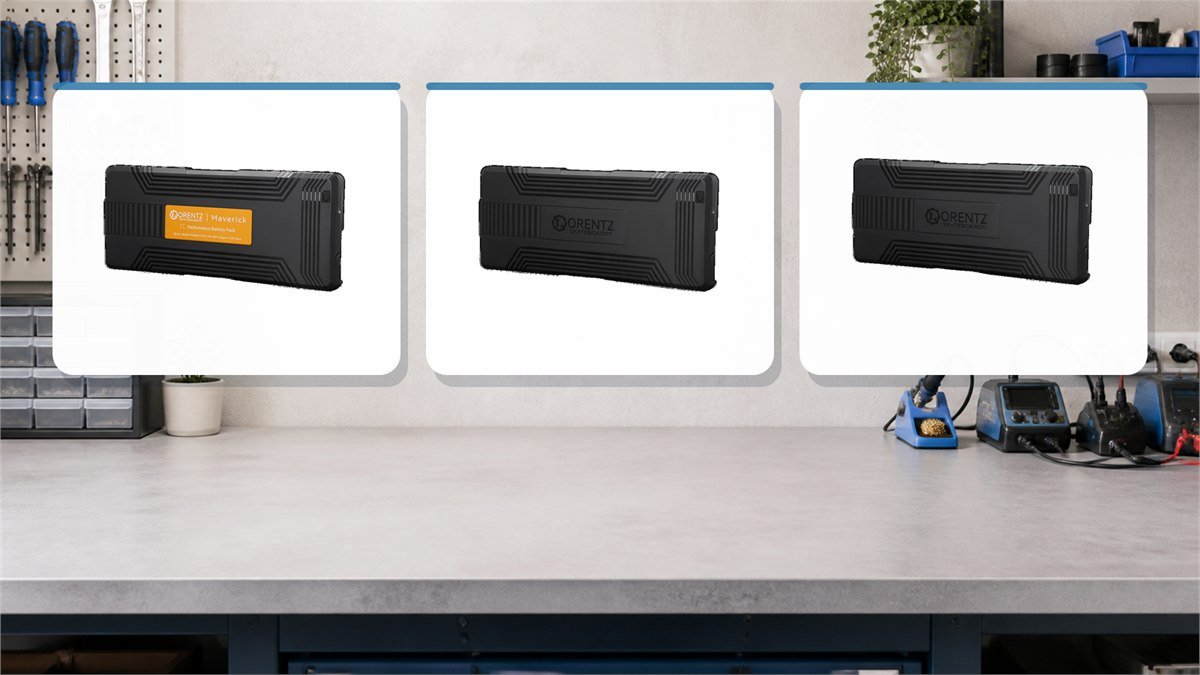
Lorentz Maverick Battery Options: Travel vs Performance vs Range, Realistic Miles, Charging Time, and Airline Rules
The Lorentz Maverick is built around a battery decision that affects more than distance. The pack changes the board’s power profile, acceleration and braking behavior, charging routine, and how realistic it is to travel with the setup. The important comparison is therefore not simply “which battery has the most range?” but “which battery fits the way the board will actually be used?”
The three choices are the 504 Wh Performance Battery, the 504 Wh Range Battery, and the 99 Wh Travel Battery. Performance and Range carry the same nominal energy, yet they use different cells and are assigned different continuous-current limits. Travel is a much smaller pack intended for short rides and easier handling, with the useful advantage of sitting just below the common 100 Wh airline threshold for a loose spare battery.
For a live view of the compatible products, current availability, tracked prices, and any available offer, see the Backfire Boards coupons, deals, and tracked prices page.
What Actually Changes Between the Packs?
On paper, the Performance and Range packs look similar because both are listed at 504 Wh and both use a 14S2P arrangement. That shared capacity does not mean they are interchangeable in feel. The manufacturer lists Molicel P50B cells and an 80 A maximum continuous discharge for Performance, while Range uses Samsung 50S cells and a 50 A maximum continuous discharge. The official pairing is Performance with Maverick Pro and Range with Maverick S.
The current limit is best read as an indication of the electrical headroom available to the system, not as a direct speed rating. Actual acceleration depends on the ESC map, motor configuration, rider weight, wheel setup, temperature, charge level, and traction. A higher-current pack can make sense for a more demanding power profile, but it cannot cancel the energy used by hills, headwind, heavy wheels, or repeated hard acceleration.

Lorentz Maverick Battery Comparison
| Battery | Capacity and layout | Listed max continuous discharge | Default charge time | Default pairing and best use |
|---|---|---|---|---|
| Performance | 504 Wh, 14S2P Molicel P50B | 80 A | About 1 h 15 min at the default rate About 50 min at the listed maximum rate | Maverick Pro Hard acceleration, demanding terrain, performance-oriented riding |
| Range | 504 Wh, 14S2P Samsung 50S | 50 A | About 3 h 40 min at the default rate About 2 h 15 min at the listed maximum rate | Maverick S Daily riding, longer steady routes, balanced response |
| Travel | 99 Wh, 14S1P | 30 A | About 2 h 15 min at the default rate About 1 h 15 min at the listed maximum rate | Optional pairing Short trips, backup range, and a smaller loose battery for travel planning |
Performance Battery vs Range Battery
Why Performance is attractive
- The 80 A listed continuous limit gives the Performance setup more electrical headroom for the Maverick Pro’s stronger power profile.
- The default charge estimate is much shorter than the Range pack’s default charge estimate.
- It is the more logical choice for steep routes, fast starts, and riders who notice throttle response more than small differences in practical mileage.
Why Range is attractive
- The same nominal 504 Wh capacity makes it the more natural distance-oriented pack for a Maverick S.
- The lower listed discharge limit is not a disadvantage for a rider who prefers smooth, controlled cruising instead of repeated maximum-current demands.
- The slower default charge is easier to accept when the board is charged overnight between regular rides.
For two riders traveling at the same speed over the same route, the packs’ nominal energy is the first reason not to expect a dramatic range difference. In real use, the Performance setup may encourage more aggressive riding, which can erase any theoretical distance advantage. Conversely, a Range-equipped board ridden quickly into a headwind can use energy much faster than a gently ridden Performance setup. Riding style is often more important than the name printed on the pack.

What the 99 Wh Travel Battery is Really For
The Travel Battery is not a second 504 Wh option. Its 99 Wh rating is roughly one-fifth of the nominal energy of the larger packs, and the 30 A listed maximum continuous discharge points to a gentler power role. It makes sense as a short-range pack, a way to keep a compact backup available, or a practical option when the rider values a smaller battery more than a full day of riding range.
The advantage is portability and the possibility of meeting a widely used airline battery threshold when the battery is carried as a loose spare. The trade-off is that the battery can be depleted quickly by speed, hills, cold weather, heavy riders, or stop-and-go riding. A plan that depends on the Travel Battery should include a conservative turnaround point rather than treating the nominal 99 Wh figure as guaranteed mileage.

Realistic Miles: What Can Be Estimated Today?
There is not yet a mature independent, controlled range test for every Maverick battery configuration. The product is new, and the early public discussion contains questions and calculations rather than a consistent set of rider logs with the same wheels, rider weight, route, temperature, and cutoff level. That makes a modeled range band more honest than a single promised number.
A useful first calculation is:
| Battery and riding pattern | Useful planning band | How to interpret it |
|---|---|---|
| 504 Wh, calm asphalt, steady speed | About 24 to 31 miles | Best-case planning territory, with favorable temperature, moderate rider load, and no hard reserve requirement. |
| 504 Wh, mixed route and normal stops | About 16 to 23 miles | A more useful everyday expectation when the route includes starts, small hills, surface changes, and a sensible reserve. |
| 504 Wh, hills, high speed, or aggressive throttle | About 10 to 16 miles | Energy consumption can rise quickly; this is where a nominal “maximum range” becomes a poor trip-planning number. |
| 99 Wh, calm short route | About 4.5 to 6 miles | Possible planning range in favorable conditions, but the rider should still keep a large buffer for the return trip. |
| 99 Wh, mixed route or repeated stops | About 3 to 4.5 miles | A safer working band for errands and short connections rather than an all-day ride. |
These are editorial planning bands, not laboratory measurements or a warranty claim. An early community discussion used roughly 40 km for a gently ridden 500 Wh setup and roughly 20 km for aggressive riding, while a separate comment put a Travel pack at approximately 5 to 7 km when keeping a reserve. Those figures are useful as a reminder of the size of the swing, but they were presented as estimates rather than tested results.
Variables that can move the result by several miles
- Speed: aerodynamic drag and motor demand rise sharply as cruising speed increases. A fast commute can use far more energy than a relaxed bike-path ride.
- Terrain: long climbs draw energy quickly; a downhill does not return all of that energy because braking, rolling resistance, and control losses remain.
- Rider and cargo: total mass affects acceleration and climbing, so a heavy backpack can matter on a hilly route.
- Wheels: wheel diameter, urethane, tread, and softness influence rolling resistance and the power needed to start moving.
- Temperature: cold cells can deliver less usable energy and can feel less responsive until warmed by normal use.
- Route behavior: frequent starts, traffic stops, and hard braking can use more energy than one smooth stretch at the same average speed.
Charging Time and Charger Choice
The charging figures below are the manufacturer’s approximate values for the listed default and maximum charge rates. They are not promises that every charge will take exactly that long. Starting state of charge, pack temperature, charger output, balancing near the top of the charge, and battery age all affect the clock.
| Battery | Default charge current and time | Listed maximum current and time | Practical charging habit |
|---|---|---|---|
| Performance | 10 A, about 1 h 15 min | 13 A, about 50 min | Useful when a ride needs a fast turnaround, but the correct charger and temperature limits still apply. |
| Range | 3 A, about 3 h 40 min | 5 A, about 2 h 15 min | Best suited to overnight or long-window charging between daily rides. |
| Travel | 1.5 A, about 2 h 15 min | 3 A, about 1 h 15 min | Shorter energy content makes the slower default rate less inconvenient than it might appear. |
Use a charger intended for the exact battery and follow the supplied charging instructions. Do not improvise a high-current charger because the numbers look compatible. After a hard ride, allow the pack to cool before charging; keep the connector and charging area dry; and stop using a pack that is swollen, cracked, unusually hot, leaking, or producing an unfamiliar smell.
How to Use the Hot-Swap Design Without Creating a New Problem
The Maverick’s removable pack is useful only if the change is made while the electrical system is in a safe state. The advertised quick-change concept should not be interpreted as permission to swap batteries while rolling, with the ESC awake, or with grit and moisture sitting on the connector.
- Stop on a stable, dry surface and switch off the remote and board.
- Open the battery access area according to the board instructions and use the pack’s own control or sleep function as intended.
- Release the pack without pulling on the connector, then place it on a clean, nonconductive surface.
- Inspect the contacts, flexible connector, and silicone sealing areas for grit, bent parts, moisture, or damage.
- Seat the replacement pack evenly, close the access cover, and confirm that the pack indicator and board startup behave normally.
- Test the throttle and brake response at walking speed before returning to normal riding.
A spare pack is also a separate object to protect. Keep its terminals covered, prevent metal tools or keys from contacting the contacts, and do not leave a loose battery bouncing around inside a backpack. The smaller Travel pack is easier to carry, but it still deserves the same terminal protection and temperature care as the larger packs.
Airline Rules: What 99 Wh Does and Does Not Mean
The Travel Battery’s 99 Wh rating is significant because FAA and IATA guidance commonly uses 100 Wh as the point at which a spare lithium-ion battery can generally be carried in cabin baggage, subject to protection and airline rules. Batteries above 100 Wh can require airline approval up to a higher limit, while batteries above 160 Wh are generally not accepted on passenger aircraft. The larger Maverick packs are far above that upper figure.
That threshold applies to battery handling, not an automatic right to bring a powered skateboard. Airlines can impose stricter rules or ban powered skateboards even when the battery is removable. For example, Delta states that it does not accept powered skateboards and similar devices using lithium or lithium-ion batteries as carry-on or checked baggage. A codeshare can add another carrier’s rule to the itinerary.
Checklist before booking a flight
- Confirm the exact Wh rating printed on the battery label or in the product documentation.
- Ask about the complete board, not just the removable battery. Some carriers prohibit the device itself.
- Ask whether the battery must be carried in cabin baggage, and how the terminals must be protected.
- Check every operating carrier and codeshare, including the return flight.
- Carry the battery in a protective pouch with no loose metal objects and never place a spare lithium battery in checked baggage.
- Do not travel with a damaged, swollen, recalled, or visibly overheated pack.
Useful general guidance is available from the FAA lithium battery rules, the FAA PackSafe resources, and IATA passenger battery guidance. These sources explain the general thresholds; the airline operating the flight remains the final practical authority.
Storage, Sleep Mode, and Battery Care
The technical FAQ describes an independent pack indicator and a sleep mode that activates during inactivity or low charge. That is useful when a battery is stored between rides, but it is not a replacement for checking the pack periodically. A battery that has been left near empty for too long can become a much larger problem than a few minutes of charging saved at the end of the last ride.
- Store the pack in a cool, dry place away from direct sun and heat sources.
- Use the pack indicator to avoid putting a nearly empty battery away for a long period.
- Let a cold or hot pack return toward room temperature before charging.
- Keep the connector and sealing surfaces clean and dry.
- Do not open the battery enclosure or attempt cell-level repairs without qualified service equipment.
- Remember that the manufacturer describes the board as not waterproof and does not recommend wet riding. A flexible connector and sealing pad reduce exposure risk; they do not make water a safe operating condition.
The published warranty information also matters when comparing ownership risk: the manufacturer lists six months for electronic parts, including the battery, while mechanical parts are listed separately. Keep purchase records, follow the charging instructions, and document a problem with photographs before attempting any modification.
Which Maverick Battery Fits Which Rider?
| Riding situation | Most sensible starting point | Reasoning |
|---|---|---|
| Maverick S used for commuting and ordinary weekend rides | Range Battery | It is the listed default pairing and keeps the full 504 Wh capacity for a balanced, distance-oriented setup. |
| Maverick Pro used for fast starts, steep routes, or performance riding | Performance Battery | It is the listed default pairing and has the higher 80 A continuous-current figure. |
| Short errands, a compact spare, or a local connection after flying | Travel Battery | The 99 Wh capacity is easier to evaluate against airline thresholds, but the complete setup still requires airline confirmation. |
| Long rides with no reliable charging window | 504 Wh pack | Both large packs have roughly five times the nominal energy of Travel, so the larger pack gives much more useful reserve. |
| Choosing only by the fastest charge time | Performance, with caution | It charges faster on the listed rates, but the decision should still start with model compatibility and desired power behavior. |
What Early Owner Discussion Tells Us
The public discussion around the Maverick is valuable mainly because it shows what potential owners are trying to verify: the real difference between Performance and Range, whether Travel is enough for a short connection, how a spare pack would be carried, and whether an airline will accept the board. It also shows why a confident range figure would be premature. Most of the early comments are questions, calculations, or reactions to the product announcement rather than long-term logs from owners using all three packs.
That distinction matters when interpreting phrases such as “28 to 31 miles” or “5 to 7 km.” They can be useful reference points from a discussion, but they are not a controlled promise for a particular rider. The most dependable decision today comes from matching the official electrical specification to the rider’s route and keeping enough reserve that the trip does not depend on the most optimistic number.
Frequently Asked Questions
Does the Range Battery go farther than the Performance Battery?
Not automatically. Both are listed at 504 Wh, so the nominal energy is the same. The practical result changes with the ESC profile, throttle use, rider weight, terrain, wheels, temperature, and reserve. Range is the natural Maverick S pairing; Performance is the natural Maverick Pro pairing.
Is the 99 Wh Travel Battery guaranteed to be allowed on a flight?
No. A loose 99 Wh lithium-ion battery fits the common general threshold used in FAA and IATA guidance, but the airline can be stricter and may prohibit the powered skateboard even when its battery is removable. Confirm the board and battery separately with every operating carrier.
How long does each Lorentz Maverick battery take to charge?
The listed approximate default times are about 1 hour 15 minutes for Performance, 3 hours 40 minutes for Range, and 2 hours 15 minutes for Travel. The listed maximum-current estimates are about 50 minutes, 2 hours 15 minutes, and 1 hour 15 minutes respectively. Actual time depends on the charger, starting charge, temperature, and balancing.
Can the Travel Battery be used with the Maverick Pro?
The technical material describes Travel as an optional pairing, but the pack’s lower current figure means it should not be treated as an identical replacement for the Pro’s default Performance pack. Confirm the exact board, ESC compatibility, and firmware requirements before using an optional pairing.
Does a removable Maverick battery make the board waterproof?
No. The technical FAQ describes the connector and sealing details but also says the board is not waterproof and wet riding is not recommended. Removability helps service and transport; it does not remove water risk.
Is a 28- or 31-mile range guaranteed?
No. Those figures should be treated as optimistic reference points from early product material or discussion. Use a conservative route estimate that accounts for speed, hills, rider mass, wheels, temperature, stops, and a reserve.
Bottom Line
The Lorentz Maverick battery choice is really a choice between response, usable range, charging rhythm, and portability. Performance and Range both provide 504 Wh, but their current limits and default board pairings point to different riding priorities. Travel is a specialized 99 Wh option that can simplify the battery side of a travel conversation, while leaving the much bigger question of whether the airline accepts the powered board.
For most buyers, the safest decision is to start with the board’s intended pairing, estimate the route using the mixed-riding band rather than the best-case number, and use Travel only when the shorter range is genuinely enough. Before ordering, compare the current Maverick listings and any available offer on the Backfire Boards coupons and deals page, then verify the exact battery and charger combination for the board you plan to ride.
Sources and Further Reading
- FAA: Lithium Batteries and Portable Electronic Devices
- FAA: Baggage with Lithium Batteries
- FAA PackSafe Resources
- IATA: Traveling with Batteries
- IATA: Passengers Traveling with Lithium Batteries
- Delta: Sporting and Leisure Goods Restrictions
- Reddit discussion: early questions about Maverick battery options and distribution
- Reddit discussion: early Lorentz Maverick release conversation