Women’s HOBIBEAR Barefoot Shoes Review: Fit, Feel, and Which Pair to Choose
There is a familiar compromise in shopping for women’s shoes: the pair that looks right squeezes your toes, while the comfortable one feels too sporty for the rest of your wardrobe. HOBIBEAR has an appealing answer, at least on paper: roomy everyday shoes that do not all look like gym equipment.
But choosing women’s HOBIBEAR barefoot shoes takes a little more care than picking a color and ordering your usual size. The brand sells different kinds of soles, several unisex sneakers, and women’s Mary Janes with a different fit altogether. A wide front is useful, but it does not tell you everything about how a shoe will feel through an afternoon of errands.
Are women’s HOBIBEAR barefoot shoes worth trying? Sage is the strongest starting point here for a simple, flexible casual sneaker. Ivy makes more sense if you prefer a covered, leather-look upper. Pilea is the dressier wide-toe alternative, but its fit complaints deserve attention, and its Mary Jane label should not be treated as proof of a particular heel drop. Choose the construction first, then check the exact model’s measurements.
First, separate a wide toe box from a barefoot sole
These terms answer different questions. A wide toe box describes space around the toes. Zero drop describes the difference in height between heel and forefoot. Stack height is the material between your foot and the ground. Flexibility is another characteristic again. A shoe can have generous toe room and still feel thick, stiff, or raised at the heel.
That distinction matters with HOBIBEAR. Sage and Ivy are sold as barefoot shoes; Hollow, for example, is currently called a wide-toe sneaker. They should not be treated as interchangeable simply because they share a logo. In an owner discussion about different HOBIBEAR constructions, repeat buyers describe noticeable changes in flexibility and fit between styles. Those reports are not laboratory measurements, but they are a useful warning against buying by brand name alone.
If you want toe space but enjoy a more substantial sole, that is a perfectly reasonable preference. You do not have to buy the thinnest shoe to make a good choice. If you specifically want a flat, highly flexible setup, however, get confirmation for the exact model and included insole rather than relying on a broad category description.
Sage vs. Ivy vs. Pilea: which kind of everyday shoe?
| Detail | Sage | Ivy | Pilea |
|---|---|---|---|
| Listed category | Barefoot sneaker | Barefoot sneaker | Mary Jane; wide-toe alternative |
| Upper and lining | Knitted upper; mesh lining | Artificial leather; mesh lining | Synthetic leather and fabric; mesh lining |
| Fastening | Laces | Laces | Hook-and-loop strap |
| Published sole detail | 4 mm rubber thickness | 4 mm rubber thickness | Rubber; no numerical thickness in the materials panel |
| Water claim | Not waterproof | Upper marketed as waterproof imitation leather | Not waterproof |
| Listed size range | EU 37–47 | EU 37–47 | EU 37–44 |
| Best reason to consider it | A casual, breathable-looking sneaker for everyday outfits | A smoother upper and less athletic appearance | A strap shoe to wear with skirts, dresses, or cropped trousers |
| Main fit check | Toe length versus midfoot hold | Instep pressure and heel security | Excess length, heel movement, and strap contact |
Construction details are manufacturer-listed, not independently measured. The 4 mm figure is not a verified total stack height including the insole. Size availability varies by color, and none of these figures establishes a measured heel-to-toe drop.
Sage: the most straightforward place to start
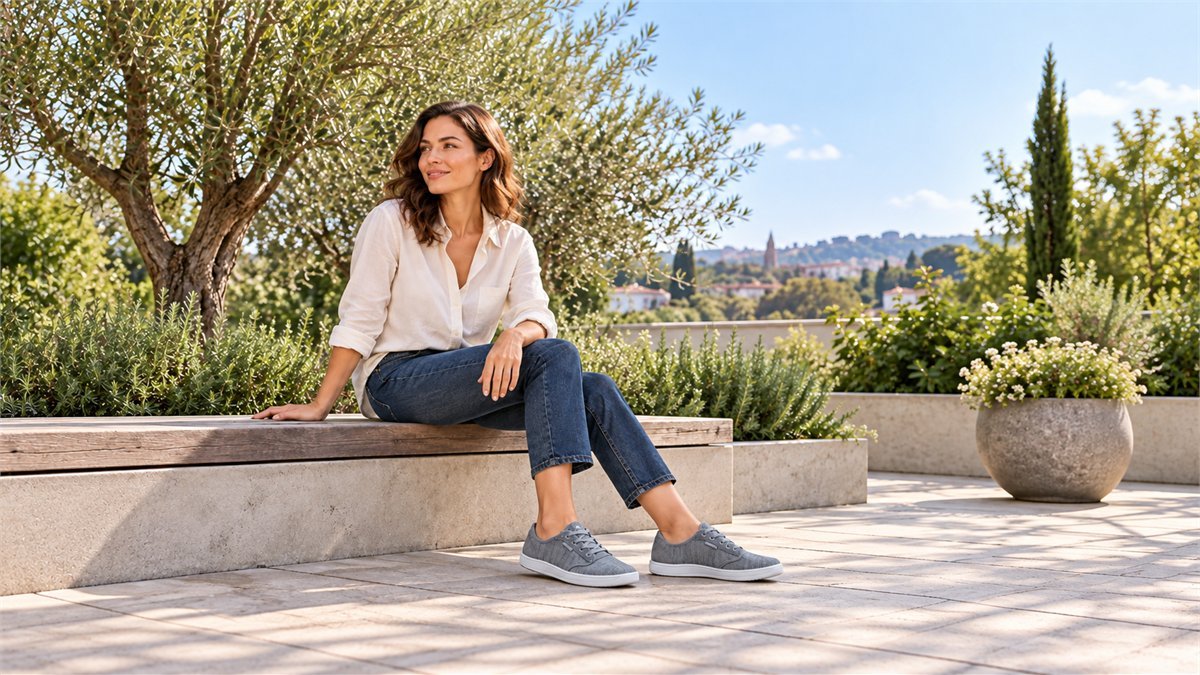
Sage looks like the kind of sneaker you could leave by the door and reach for without planning an outfit around it. The low profile, conventional laces, and textured upper keep it closer to an everyday trainer than a specialist exercise shoe. In light gray, it would sit comfortably alongside straight-leg jeans, cotton trousers, or a relaxed midi skirt.
The reason to shortlist it is simplicity. You can adjust the laces through the middle of the foot without deliberately pulling the front tight. That is a more useful starting point than sizing up a narrow sneaker until your heel starts sliding around.
A Sage owner’s first impressions and later follow-up describe a flexible sole, generous toe space, and a removable insole. The same owner found the shoe heavier than their cheap foam running shoes and initially noticed a slapping sound on pavement. Later, they still liked the pair and no longer found the noise bothersome. That is a more useful picture than an uncomplicated claim that minimalist shoes always feel weightless.
The compromise: a flexible casual shoe is not automatically a plush one. If your favorite walking shoes work because they cushion hard pavement, do not expect the same sensation here. Start with an ordinary short outing, not the longest day of a sightseeing trip. Sage’s appeal is freedom of movement and a relaxed shape, not a promise that you will forget every surface underfoot.

Ivy: a cleaner look, with a different upper to consider
Ivy takes the same general shopping problem in a less casual-looking direction. The smooth upper, especially in black, is easier to imagine with dark trousers and a simple jacket than a conspicuously knitted trainer. It is still a sneaker, but it may fit an understated wardrobe better.
Its material is artificial leather, not genuine leather. That distinction matters if you are expecting traditional leather care, polishing, or a particular kind of break-in. The current upper is also marketed as waterproof. Treat that as a manufacturer claim about the material, not proof that the complete shoe is suitable for sustained rain, deep puddles, or wet-weather hiking.
Model-labeled owner feedback points in both directions on warmth. Some find Ivy comfortable for a working day; one recent black-pair buyer mentions extra heat. A covered upper is therefore worth thinking about if you usually find closed shoes stuffy. Conversely, someone who dislikes the exposed feel of knitted footwear may prefer it.
The fitting detail to watch is the top of your foot. A shoe can have enough space in front while pressing across the instep. Loosen the laces properly before trying it on, then check whether the upper lies comfortably when you bend and take a step. Pressure that requires you to leave the shoe almost unsecured is not a good trade for toe room.

Pilea Mary Janes: attractive, but be especially careful with sizing
A sneaker is not the answer to every outfit. Pilea’s Mary Jane shape offers a more dressed-up route, with a fabric-and-synthetic upper and a strap rather than laces. The pale version has a lace-like texture that would work with summer skirts; darker colors give the same silhouette a quieter look.
The strongest positive theme in Pilea’s customer feedback is the combination of appearance and toe room. The clearest negative theme is excess size: multiple buyers describe a pair that feels too long or loose. There are also reports of heel or strap irritation and difficult returns. None of this proves that every pair runs large, and some complaints involve size-label confusion, but it makes a blanket recommendation to size up particularly unhelpful.
A strap can hold the midfoot; it cannot correct a shoe that is fundamentally the wrong length or shape. If the heel still lifts when the fastening is comfortable, tightening it harder is unlikely to make the shoe an enjoyable daily choice.
Pilea belongs on the shortlist for its style, not as a verified zero-drop substitute for Sage. Its materials panel does not establish the full sole geometry. Ask for that detail if strict barefoot construction is essential to you.

How to choose a women’s size without guessing
The most expensive size is the one you cannot comfortably wear. With unisex listings, whole EU sizes, and different model shapes in the mix, a familiar US number is only a starting point. Keep three things separate: the size you selected, the measurement in the chart, and the label on the shoe that arrives.
Measure the foot, then read what the chart measures
Measure both feet while standing, using the socks you expect to wear. Fit the larger foot, and check later in the day rather than immediately after getting out of bed. These are also central points in the American Orthopaedic Foot & Ankle Society’s shoe-fitting guidance.
HOBIBEAR’s selected product pages state that insole length should exceed foot length by 1–1.4 cm. That is an insole-length allowance, not a command to add that amount to every chart. If a chart already gives recommended foot length, adding it again could leave you with too much shoe. Ask which measurement a column represents when it is unclear.
For example, a 24 cm foot plus a 1–1.4 cm allowance gives a target insole length of 25–25.4 cm. It does not, by itself, identify a universal EU or US size. You still need the exact model’s chart and enough width and depth for your foot.
Toe shape matters as much as the widest point
Two feet can have the same overall width but need different shoes. One may have a long second toe; another may need more room along the little-toe side. A broad-looking toe box is not helpful if its taper meets your longest toe too early. In a discussion of wide women’s footwear, shoppers describe inconsistent fits even between HOBIBEAR styles. That is why another buyer’s size conversion is less useful than a clear description of where the shoe presses.
Do not solve side pressure simply by adding more length. You might gain a little room in front and lose the secure heel that makes walking comfortable. For an unusually wide forefoot, high instep, or narrow heel, ask for model-specific measurements before ordering several pairs.
The indoor try-on that tells you more than a mirror
Keep the packaging and test the shoes on a clean indoor surface while they are still returnable. Looking down at a roomy front is only the beginning. The useful question is whether the shoe stays with your foot without squeezing it.
| Check | A promising fit | A reason to reconsider |
|---|---|---|
| Longest toe | Can straighten without touching the front | Bumps the end as you walk or bend |
| Forefoot | Toes can move without pressure along the sides | Little toe or big-toe joint presses against an edge |
| Heel | Feels secure at comfortable lace or strap tension | Repeated slipping, rubbing, or an urge to grip with your toes |
| Instep | Upper lies comfortably when standing and stepping | Pressure, tingling, or a fastening that must be overtightened |
| Bending point | Shoe flexes without a fold digging into the foot | A seam, crease, or strap creates a repeated hot spot |
Walk, turn, sit, and stand again. Use the socks you actually plan to wear, not a thicker pair introduced to rescue an oversized shoe. A no-show sock can also change where the collar touches the heel, so test that combination before deciding a Mary Jane or low sneaker will work sockless.
What the owner feedback means for everyday use
The encouraging pattern is easy to understand: buyers who get a compatible shape often appreciate having room for their toes without wearing an overtly orthopedic-looking shoe. That is a meaningful everyday benefit. It does not establish that the shoes correct foot problems or suit every person who finds conventional footwear uncomfortable.
The less encouraging pattern is inconsistency. Positive accounts of repeat purchases sit alongside complaints about size conversions, different fits between styles, internal rubbing, and the effort of arranging a return. Rather than dismissing either group, use the disagreement to make your first order smaller and your fit checks more deliberate.
Durability remains a personal-use question, not a dependable number of months. A daily commuter, someone rotating several pairs, and a person wearing one pair occasionally are asking very different things of a shoe. Before keeping yours, inspect the sole bond, both heel linings, seams, and fastenings. A defect on arrival is different from normal wear and should be documented before the pair goes outside.
Read the return conditions before trying a new size. The brand’s .com FAQ requires contact within 30 days of delivery, an approved return request, unused shoes, and original packaging. For customer-choice returns, return shipping is generally the buyer’s responsibility; the FAQ separately assigns damaged or incorrectly supplied orders to the seller. This is not an unrestricted outdoor wear trial.
Walking, standing, and workouts: set the right expectations
Errands and travel
For casual wear, the decision is pleasantly simple: do you like the fit enough to reach for the shoes again? Test them on familiar days before packing them as your only travel pair. An attractive sneaker that works for the school run may still be the wrong choice for a week of long museum queues and paved streets.
Standing at work
Walking and standing are not the same experience. If your day involves a mostly stationary position on a hard floor, prioritize comfort under that specific demand. More toe room does not guarantee the cushioning or support you prefer. Check your workplace requirements separately: a rubber sole or a retailer’s slip-resistance claim is not a substitute for the safety certification your job requires.
Running and gym sessions
Do not turn a successful casual-shoe fitting into an immediate change to your whole running routine. An orthopaedic perspective published by AAOS notes that evidence does not establish minimalist running as universally less injurious and warns against changing too quickly. A good walking fit also says little about suitability for lateral court movements or demanding training.
Keep initial wear brief and build gradually if comfortable. Stop if pain develops rather than treating it as proof that the shoes are working. If you have an existing foot condition, persistent pain, or prescribed orthotics, ask your clinician before changing your usual support. Comfort is the goal; there is no prize for forcing a minimalist setup to work.
Care: keep the upper clean without making the shoe a project
HOBIBEAR’s general care advice favors hand cleaning with a neutral detergent, without prolonged soaking or high-heat drying. That is a sensible starting point, with the instructions supplied for your particular pair taking priority. Do not assume that a knitted sneaker, imitation-leather upper, and decorative Mary Jane should all go through the same wash cycle.
For small marks, begin with the least aggressive approach: a soft cloth or brush and a little mild cleaning solution, tested in an inconspicuous spot. Avoid saturating the lining. Let the pair dry naturally before wearing it again, and keep it away from a radiator or tumble dryer.
White and pale shoes also need realistic expectations. If your usual route leaves dark dust around the sole edge, decide whether you enjoy keeping pale footwear tidy before choosing a color. A slightly darker everyday pair may suit your routine better than a pristine-looking one you hesitate to wear.
Which pair would make the most sense?
Worth shortlisting
- Sage: you want a simple casual sneaker and are comfortable exploring a less cushioned feel.
- Ivy: you prefer a smoother, more covered upper and understated styling.
- Pilea: you want a roomy Mary Jane and are willing to resolve the model-specific fit before keeping it.
Consider something else when
- You need precisely documented stack height and heel drop before ordering.
- You rely on substantial cushioning or a prescribed support arrangement.
- You need certified work protection, dependable wet-weather coverage, or an easy outdoor trial.
The best first purchase is one pair that solves a real wardrobe problem. Perhaps that is the casual sneaker you can wear with jeans without cramped toes. Perhaps it is a strap shoe for a dress. Start there, confirm the fit, and only then think about another color. A lower price is useful; a pair you actually wear is better value.
Once you have chosen the model and size, check HOBIBEAR coupons and deals for current offers. Compare the final delivered cost and return terms, not just the crossed-out price.
Women’s HOBIBEAR shoes: common questions
Are all HOBIBEAR shoes zero drop?
No brand-wide assumption is safe. The catalog includes both barefoot-labeled shoes and wide-toe sneakers. Check the particular model and insole; a broad toe box alone does not establish heel-to-toe drop.
Should women size up in HOBIBEAR shoes?
Not automatically. The feedback is model-dependent, and Pilea has repeated reports of excess length or looseness. Use the model’s measurements and confirm whether the chart describes foot length or insole length.
Can I wear them with socks?
Yes. Choose the sock thickness you intend to use before judging fit. A thicker sock takes up space, while a low-cut sock can leave the heel collar touching bare skin. Neither should be used to disguise a fundamentally poor fit.
Are HOBIBEAR shoes good for bunions or plantar fasciitis?
Some owners appreciate the extra toe room, but these shoes should not be presented as treatment for either condition. A roomy front and the amount of support you need are separate questions. Seek advice for painful or persistent symptoms.
Can I wear an orthotic in them?
Only if the shoe has suitable internal depth, a compatible removable insole, and adequate heel hold with your orthotic fitted. Do not assume all HOBIBEAR models meet those conditions. Keep prescribed support decisions with your clinician.
Which is better for dresses: Sage or Pilea?
Pilea has the more conventional dress-shoe outline; Sage works better for a casual sneaker-and-dress look. The more attractive silhouette is not the better purchase if the heel slips or a strap rubs.
Further reading
DiscountedSavings may earn a commission from qualifying purchases through product links.